Australia's 9 Fix Everything Switches
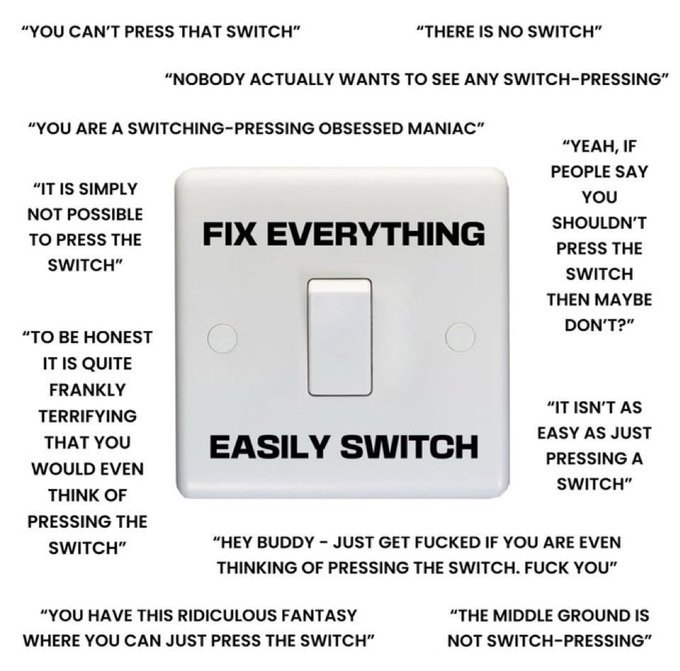
Australia's malaise is a switching problem, not a money problem. Nine levers already exist in legislation, regulation, or signed agreements. Pull them.
Good evening readers,
In today's Innovation Commons: a policy essay circulating on GitHub argues that Australia has become very good at distributing scarcity and very bad at building capacity. We agree with the diagnosis. We want to go further. For every plank in that essay there is a specific, named, already-on-the-books switch the country can throw nationally. The switches are not theories. They are statutes, regulations, intergovernmental agreements, or independent reviews that government has already paid for and then declined to use at full strength.
This piece names nine of them. Let's get into it.
The Capacity Agenda essay, published as a GitHub gist by 17twenty in November 2025, frames Australia's stagnation as a governance bias protecting scarcity rather than rewarding building. The argument is correct. We think there’s some more work that sits at the join: matching each diagnosed failure to the precise switch already wired into Australian law that, if pulled at scale, would resolve it.
We call these fix-everything switches because each one collapses several of the essay's separate complaints into a single regulatory or legislative act. There are nine. Most of them have been recommended by a federal review, agreed at National Cabinet, or written into legislation already.
The reason they have not been pulled is political, not technical.
Switch one: Housing abundance is a zoning override, not a subsidy
The essay calls for legalising apartments and townhouses near transport and overriding local vetoes. The switch already exists. In December 2023 the NSW Government introduced the Transport Oriented Development Program, rezoning land within 400 metres of 37 metro and rail stations to permit residential flat buildings and shop-top housing up to six storeys as-of-right. The accelerated precinct overlay, announced November 2024, layers additional density on eight further sites (ABC News, 27 November 2024).
The switch is the as-of-right designation. It removes local council discretion from the consent pathway. Pulled at national scale, every capital city, every train and tram station, every regional centre on a frequent bus corridorhis single instrument addresses cost of living, productivity, migration absorption and fertility in one move. Productivity Commission chair Danielle Wood conceded in April 2026 that current settings will take decades to filter through (MacroBusiness, 26 April 2026). Filtering is what scarcity does. Override is what abundance does.
Switch two: Stamp duty to land tax is a 20-year switch the ACT already wrote
The essay calls for replacing stamp duty with broad land tax. The ACT has been doing exactly this since 2012 under a 20-year transition that abolished stamp duty in stages and replaced the revenue through higher general rates (Prosper Australia). Treasury forecast error on revenue fell from 7.9% to 2.6% across the reform period. Tthat is the kind of fiscal discipline land tax delivers and stamp duty cannot (Prosper Australia).
The Grattan Institute estimated in 2016 that nationwide adoption of the ACT model would lift Australian living standards by around $30 billion a year (Grattan Institute, 19 October 2016). The McKell Institute published a transition design in 2022 that protects recent stamp duty payers and offers rate deferral for asset-rich, cash-poor retirees (McKell Institute, 2022).
Switch three: Automatic Mutual Recognition is already law. Most occupations are missing.
The essay calls for national licensing where possible and automatic recognition of trusted standards. The Commonwealth Mutual Recognition Act 1992 was amended in 2021 to introduce Automatic Mutual Recognition (AMR), which allows a tradesperson or professional licensed in their home state to work in another state without applying for a second licence or paying a second fee (NSW Government). NSW, Victoria, the ACT and the Northern Territory began the scheme on 1 July 2021 (Victoria DTF).
The Productivity Commission estimated AMR would lift output by roughly $2.4 billion over ten years. The catch is scope. Many occupational licences are still excluded, particularly in construction, where the country says it needs hundreds of thousands more workers. The switch is the inclusion schedule. Expanding AMR to every construction trade, every nursing registration, every teaching qualification (without further state-level vetoes) is a one-line regulatory amendment. The country has already spent the political capital to write the head act. The job is finishing it.
Switch four: The Henry Review is the tax switchboard
The essay calls for serious tax reform: broad land tax, tighter housing concessions, fairer super at the top, proper resource rents. Treasury's 2010 Henry Tax Review delivered 138 recommendations covering exactly this surface. Rudd implemented three (Wikipedia summary of Henry Tax Review). The remaining 135 are still sitting in a published report. They include a uniform land tax, neutral treatment of rental versus owner-occupied housing, full expensing for business investment, and a properly designed resource rent tax.
The 2024 amendments to the Petroleum Resource Rent Tax show what activating one Henry recommendation looks like: revised transfer pricing rules, an irrevocable election on asset-life formulae, and tightened anti-avoidance rules. The Henry switchboard has 134 more switches behind glass. Each one was costed by Treasury. The country knows what to do.
Switch five: Migration is a list, and the list is the lever
The essay calls for migration redesigned around a single test: does this build Australia? On 7 December 2024 the Government commenced the Core Skills Occupation List (CSOL), a single consolidated list of 456 occupations replacing the fragmented skilled, regional and short-term lists that previously ran in parallel (Jameson Law, 6 December 2024; Jobs and Skills Australia, 2024 CSOL Key Findings Report).
very occupation on it gets fast-tracked employer sponsorship. Every occupation off it does not. Bricklayers, registered nurses, electricians, transmission engineers, civil engineers, child-care educators, GPs and cyber security specialists are on. Sham low-wage pathways are off. The list is recompiled annually by Jobs and Skills Australia with industry consultation. Compressing it harder against the country's construction, energy and care priorities converts migration policy from a population debate into a capability lever. It is the same instrument either way. The setting is what changes.
Switch six: Rewiring the Nation is the AEMO Integrated System Plan
The essay calls for cheap, reliable clean energy. AEMO's 2024 Integrated System Plan is the optimal development path for the National Electricity Market through 2050: roughly 10,000 km of new transmission, 29 GW of onshore wind, 7 GW of utility-scale solar, 19 GW of distributed solar, storage, firming gas, and the coordinated retirement of 90% of coal capacity by 2035 (AEMO, 26 June 2024).
The ISP is not a vibe. It is a stochastic optimisation across more than 1,000 candidate development paths, tested against scenarios including Green Energy Exports (S&P Global, 12 July 2024). It tells the country which transmission line to build first, where the renewable energy zones go, and what storage capacity must be procured by when. The Commonwealth's Rewiring the Nation finance facility was designed to underwrite it. The switch is the speed of approvals for the actionable transmission projects. Two of them (Sydney Ring South and QNI Connect) were elevated to actionable status in the 2024 plan after delivery delays. Treating the ISP as the binding national infrastructure document, rather than a market participant's advice, collapses energy policy theology into a build queue.
Switch seven: Universal preschool is a Productivity Commission report and a signed agreement
The essay calls for human capital reform starting with early childhood. The Productivity Commission's September 2024 final report on early childhood education and care laid out a universal system: 30 hours or three days a week of high-quality ECEC for every child aged 0–5, with means-tested cost relief targeted at families earning under $80,000 a year (Productivity Commission, 18 September 2024). The Preschool Reform Agreement, signed between the Commonwealth and all states and territories, is the funding vehicle (Department of Education).
The switch is the funding ratchet inside the Preschool Reform Agreement. The mechanism for matched Commonwealth/state contributions and outcomes-based reporting is already in place. Lifting the per-child funding multiplier and tying it to attendance and quality metrics turns the Agreement from an indexation device into a capability-building one. The infrastructure to do this exists. The political decision to use it as the country's primary human capital lever has not been made.
Switch eight: Foundational Supports is the NDIS pressure valve
The essay calls for protecting the NDIS for people with profound and permanent disability while rebuilding its boundaries. The National Agreement on Foundational Supports 2026–2031, signed by the Commonwealth and states in March 2026, is the explicit mechanism for delivering a tier of disability support outside the NDIS, jointly funded and nationally consistent (Federal Financial Relations, March 2026). The NDIS Review's December 2023 framing was that Foundational Supports would improve and expand programs previously delivered through the Information Linkages and Capacity Building grants (NDIS Review, 7 December 2023).
The switch is the speed of stand-up. Until Foundational Supports operate at scale the pressure on the individual support pathway will continue to compound. Resourcing the Foundational tier properly is the boundary the essay asks for. The Agreement is the legal instrument. The execution sits with state Health and Disability ministers.
Switch nine: Sovereign capability is a list of seven priority areas
The essay calls for strategic resilience without lazy nationalism. The National Reconstruction Fund Corporation, established under the NRFC Act 2023 and capitalised at $15 billion, invests through debt, equity and guarantees across seven legislated priority areas: renewables and low-emissions technologies, medical science, transport, value-add in agriculture/forestry/fisheries, value-add in resources, defence capability, and enabling capabilities including AI, advanced manufacturing, robotics and quantum (Finance Australia; NRFC).
The switch is the discipline of the priority list. Seven categories is approximately the right surface area for a country of 27 million people. Every subsidy proposal should be measured against the legislated priority areas, not against political proximity. The instrument is in place. The test the essay asks for is whether Cabinet uses the NRFC's mandate as the gate or routes around it.
What this means for now
The Capacity Agenda essay is right that Australia's problem is a governing bias toward scarcity. It is missing the next-order observation: the country has already done most of the work needed to switch the bias. Henry, Samuel, Callaghan, Productivity Commission ECEC, the NDIS Review, the AEMO ISP, the AMR scheme, the TOD program, the NRFC priority areas, the Preschool Reform Agreement, the National Agreement on Foundational Supports — these are not aspirations. They are mechanisms. Each was written, costed, reviewed and in most cases signed.
What to take from this
Australia has nine fix-everything switches already on the legislative books. The blocker is political, not technical.
The TOD as-of-right model and the ACT stamp duty transition are the highest-leverage levers — they collapse the largest number of separate complaints into single instruments.
AMR, the CSOL, and the NRFC priority areas are mechanisms designed to be tightened. The right policy question is the setting, not the existence.
The AEMO Integrated System Plan, the Preschool Reform Agreement and the National Agreement on Foundational Supports are signed delivery instruments. Treating them as binding rather than indicative is the cheapest reform available.
The Henry Review remains the country's largest unexecuted tax reform document. 135 recommendations sit on the shelf.
— The Editor