How Steel & Nitrogen (Invisibly) Shaped the Modern World
The steel boxes, chemical reactions, and engineered grains that built the modern world.
Editor’s Note: Happy (belated) Labour Day to my fellow Victorians and Tasmanians. Melbourne was the first place in the world to achieve an 8-hour working day without loss of pay on 21st April 1856 (a short tram-ride away from this newsletter’s publishing office!)
In recognition of this, this newsletter features major 20th century innovations from around the world in agriculture and shipping (traditionally labour dominant industries)
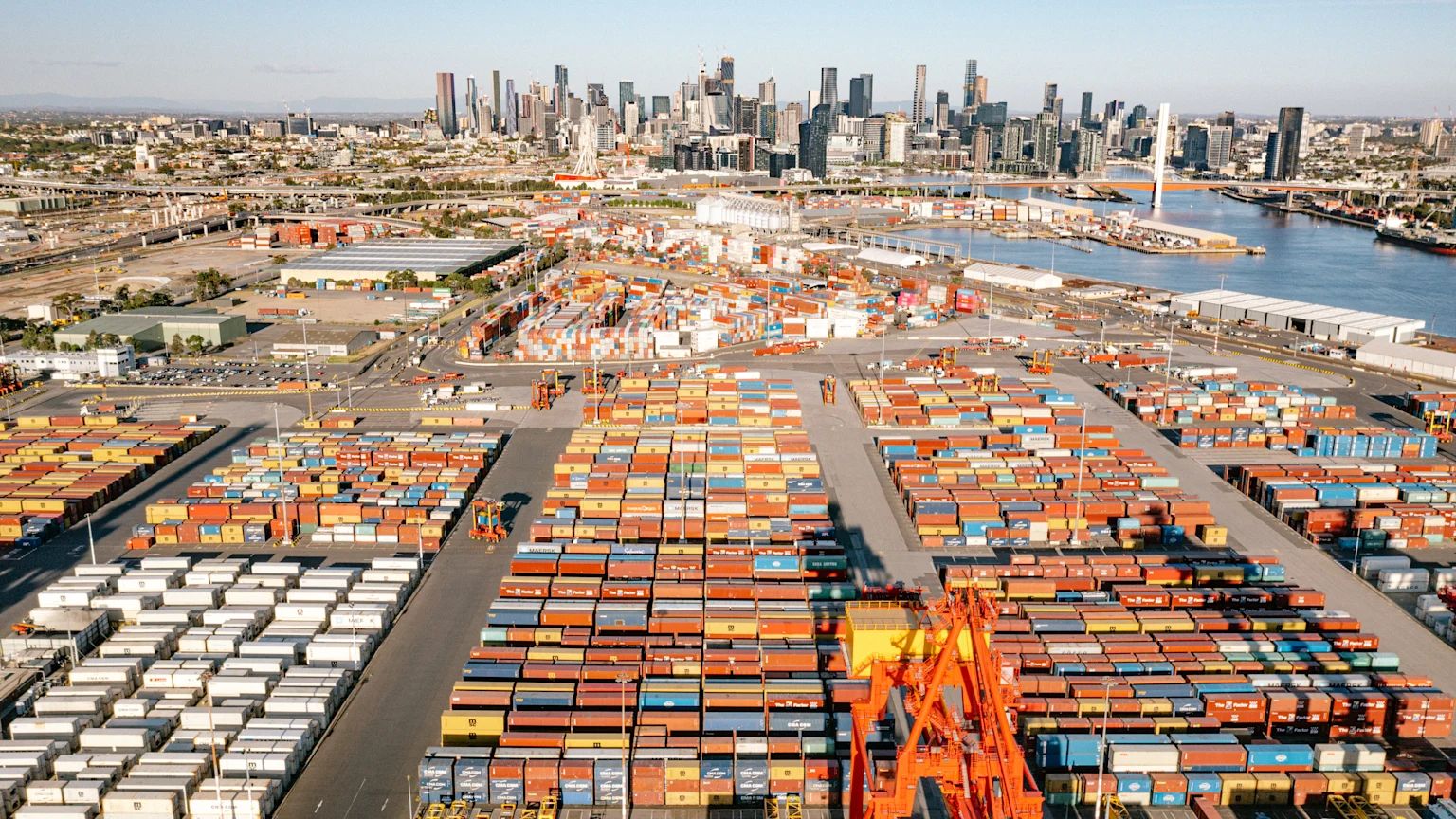
Swanson Dock, with a view of Melbourne in the background. (source: The Age)
Steel, Nitrogen, and the Quiet Architecture of the Modern World
Stand at the edge of any major port and you will see them: towers of steel boxes stacked twelve high, painted in sun-bleached reds and blues, sliding off container ships the length of four city blocks. They are so ordinary that they barely register. That is precisely the point.
The shipping container is one of the great invisible revolutions in human history. Before 1956, loading a ship was slow, expensive, and chaotic, a medieval operation dressed in industrial clothing! Goods arrived at the dock in barrels, crates, and bales. Longshoremen loaded each piece by hand, one at a time, in a process that could take days. Cargo disappeared routinely. Damage was commonplace. Loading cost roughly $5.68 per ton, and every link in the supply chain absorbed its own friction.
Then a trucking entrepreneur from North Carolina named Malcom McLean had an almost embarrassingly simple idea. Instead of unloading cargo from a truck and reloading it onto a ship, why not just put the whole truck body on the boat? From that instinct came the standardised intermodal container — 33 feet long, 8 feet wide, 8 feet high — and with it, the cost of loading a ton of cargo collapsed to $0.19. Not an incremental improvement. A 97% reduction.
What followed was not merely an efficiency gain but a reorganisation of the world economy. The container did not just make shipping cheaper; it made global manufacturing coherent. A pair of trainers assembled in Vietnam, stitched with thread from Bangladesh, soled with rubber from Indonesia, boxed in a factory in Guangzhou, and purchased in Melbourne three weeks later — that entire chain of custody rests on the humble logic of a steel box that fits the same slot on every ship, truck, and train on earth.
The Limits of Going Bigger
Success, of course, breeds its own complications.
Ships have grown in pursuit of economies of scale, and the results are staggering. The largest container vessels operating today can carry around 24,000 containers - enough to stretch, stacked end to end, from Melbourne to Canberra. Over the past two decades, the average ship size has more than doubled.
Yet somewhere past a certain threshold, the logic inverts. Mega-ships require deeper ports, larger cranes, and longer docking windows. They burn more fuel. A vessel too large for its destination port is a floating liability. The efficiencies that drove the push for size begin to cannibalise themselves, which is why the race to build ever-larger ships has slowed considerably. Innovation, it turns out, does not move in a straight line. It accelerates, overshoots, corrects.
The Invention That Fed the World…and Armed It
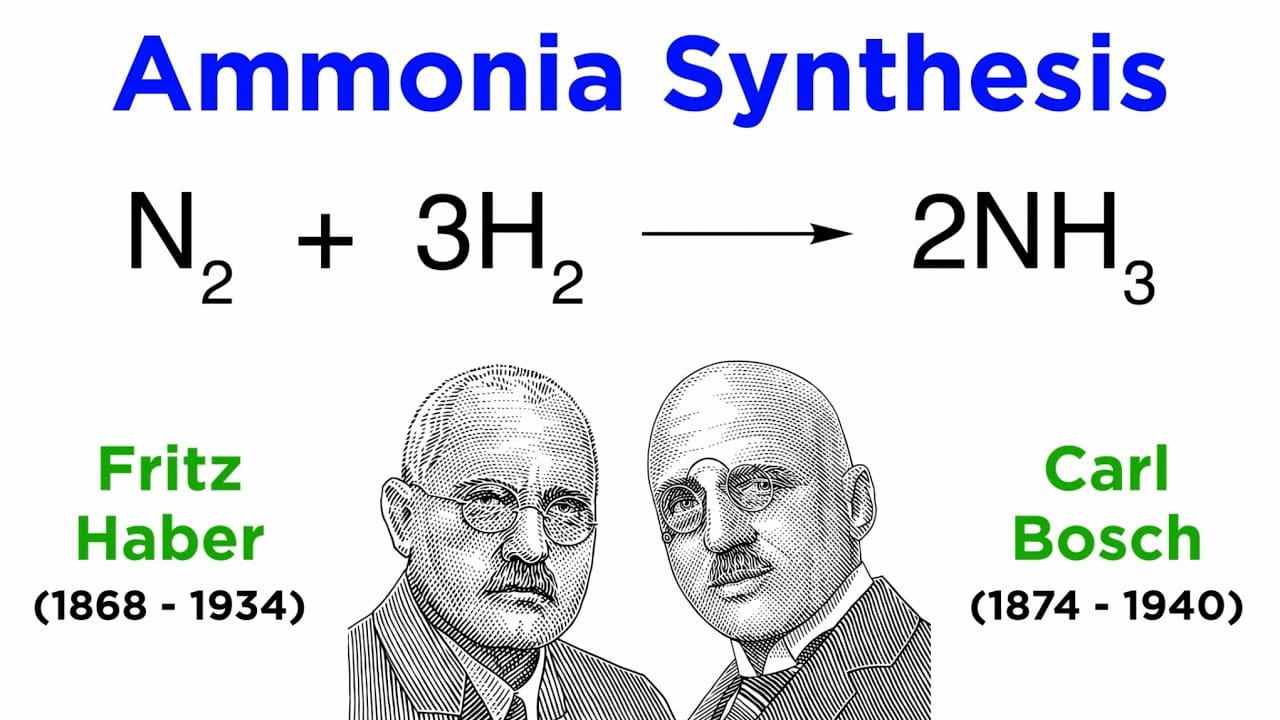
source: Professor Dave Explains
Some innovations carry consequences that their inventors could not have imagined, and perhaps would not have wanted to.
In the early twentieth century, two German chemists — Fritz Haber and Carl Bosch — developed a method to pull nitrogen directly from the atmosphere and convert it into ammonia on an industrial scale. The Haber-Bosch process, as it became known, solved a problem that had quietly constrained human civilisation for millennia: how to replenish soil nutrients at the scale that a growing global population demanded. Synthetic nitrogen fertiliser could now be produced in virtually unlimited quantities.
The results were staggering. Agricultural yields across the world began to climb. The threat of mass starvation that had shadowed the early twentieth century receded. Today, roughly half of the nitrogen atoms in the human body are estimated to have passed through a Haber-Bosch reactor. In the most literal sense, synthetic fertiliser built us.
But Haber-Bosch has another history, one harder to commemorate. The same chemistry that fed the world also enabled the large-scale production of explosives. Haber himself would go on to direct Germany's chemical weapons program during the First World War, overseeing the first large-scale deployment of chlorine gas in combat. A single process, two radically different applications. One civilisation fed; another poisoned.
This ambivalence is not unique to Haber-Bosch. It is almost characteristic of foundational technologies. The question has never simply been what a thing can do, but what we choose to do with it.
Today, researchers are probing the process's next iteration. Almost all ammonia production still depends on fossil fuels - a significant source of industrial carbon emissions. Green ammonia, produced using renewable energy rather than natural gas, could transform the process yet again, this time as a pathway into the hydrogen economy. The invention keeps evolving, dragging its consequences behind it.
The Golden Grain

source: Britannica.com
In the late 1990s, two plant scientists, Ingo Potrykus and Peter Beyer, introduced a rice variety that did something ordinary rice cannot: it produced beta-carotene, the compound the body converts into vitamin A.
The modification required inserting two genes into the rice genome, one from maize and one from a common soil bacterium. The result turned the grain a faint golden yellow. Golden Rice, as it came to be known, was not an aesthetic choice, rather a visual marker of a nutritional intervention aimed at one of the world's most persistent public health crises.
Vitamin A deficiency affects hundreds of millions of people, concentrated in regions where rice is a staple and dietary diversity is limited. The deficiency impairs immune function, stunts development, and in its most severe form causes irreversible blindness in children. In communities where rice comprises the overwhelming majority of daily caloric intake, the gap between what the grain provides and what the body needs is not a marginal problem. It compounds across generations.
Second-generation Golden Rice varieties can produce 20–30 micrograms of beta-carotene per gram of grain. This enough, even accounting for storage losses, to make a meaningful contribution to daily vitamin A intake for people eating it as a staple. Local research institutions in Bangladesh and the Philippines, the countries where the deployment effort has been most concentrated, have developed regionally adapted varieties that perform comparably to conventional rice in yield, cultivation requirements, and cost.
Why a Life-Saving Crop Remains Mostly Unplanted
And yet Golden Rice is not widely grown. In Bangladesh, regulatory approval remains pending. In the Philippines, legal challenges brought by anti-GMO advocacy groups halted further research and implementation, producing a multi-year setback for a technology that had already taken two decades to reach trial stage.
The objections raised against Golden Rice are not entirely frivolous. Concerns about ecological disruption from genetically modified crops are legitimate areas of scientific inquiry. Arguments that micronutrient deficiency requires systemic solutions — dietary diversification, economic development, public health infrastructure — rather than a single biofortified crop are also valid. These are genuine debates.
But there is a harder question embedded in the controversy: at what cost does precaution come? Globally, around 22% of children under five experience malnutrition severe enough to cause stunting. Micronutrient deficiencies in the first thousand days of life leave cognitive imprints that no subsequent intervention fully corrects. The children affected by delays in Golden Rice deployment are not abstractions.
Golden Rice was never positioned as a complete solution. Its developers were explicit that it addresses one specific deficiency in one specific dietary context. That limitation is not a weakness — it is clarity of purpose. The question is whether societies and regulatory systems are capable of evaluating specific interventions on their specific merits, or whether every biotechnology tool gets weighed down by the aggregate anxieties of a much larger argument.
The Invisible Infrastructure
The shipping container, the Haber-Bosch process, Golden Rice — none of these are glamorous. They do not generate the mythology attached to software revolutions or space programs. They operate in the background, structuring the conditions of daily life so completely that they become invisible.
That invisibility is, in a way, the mark of their success. The most consequential technologies are often those that stop feeling like technologies at all.
They simply become the way things are, the air through which everything else moves. Recognising them requires a deliberate act of attention, a willingness to look past the surface of ordinary things and ask how they came to be ordinary in the first place.