Sinew & Silicon
How a national sporting humiliation built the world's most advanced athlete-tracking industry, and how to affects the machinery reading other living things.
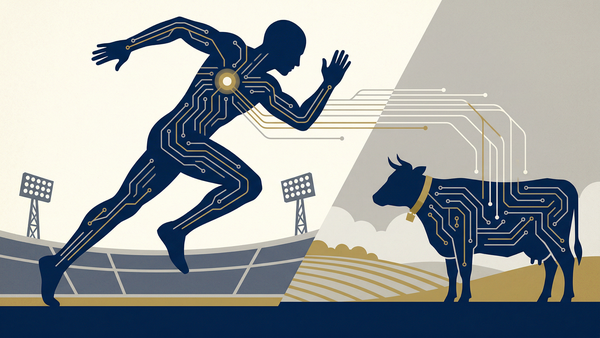
Editor's note: In 1976, Australia sent 184 athletes to the Montreal Olympics and came home without a single gold medal. The national embarrassment was so acute that it restructured the entire apparatus of Australian sport. This edition traces that lineage, and asks what it means now that the same logic of reading bodies through data is spreading from the stadium to the paddock, the factory floor, and the simulation lab.
Ethical and philosophical questions remain, but the technical fact is plain. The thread running through this edition is a simple one: we are getting better at reading bodies.
Innovation Spotlight: From Humiliation to a Billion-Dollar Body
Stand on the sideline of any AFL match, any English Premier League training session, any NFL practice field, and you will notice a small bump between the shoulder blades of almost every athlete on the pitch. It sits beneath the jersey, barely visible — a GPS-and-inertial-sensor unit no larger than a matchbox, capturing hundreds of data points per second: acceleration, deceleration, change of direction, total distance, sprint load, collision intensity.
The device is almost certainly made by an Australian company.
Catapult Sports, headquartered in Melbourne, holds roughly 18% of the global sports wearable tracking market and serves more than 4,600 elite teams across 40 sports worldwide. Its revenues exceeded US$116 million in FY25, up 16.5% year-on-year. Its market capitalisation surpassed $1.6 billion in mid-2025, with its share price gaining more than 200% in a single year. This is not a startup story. It is the quiet commercialisation of a fifty-year Australian project that began with failure.
The Montreal Catalyst
Australia's relationship with elite sport is not casual. National identity and Olympic performance are woven together in ways few other countries replicate. When the 1976 Montreal Games delivered the worst result since Berlin in 1936 (five medals, zero gold) the public response was not resignation but structural reform. Prime Minister Malcolm Fraser established the Australian Institute of Sport in 1981, embedding a principle that no other country had yet formalised at scale: that sport could be approached as an engineering problem.
The AIS did not simply build better gyms. It built biomechanics laboratories. By the mid-1970s, the University of Western Australia had already established Australia's first sports biomechanics lab — using optical light tracing techniques to quantify treadmill running kinematics. The AIS expanded this thinking nationally, hiring physiologists, biomechanists, and data scientists before most of the world had a name for the role. Australia, as ESPN later observed, became "the birthplace of sports science."
From the Lab to the Field
The problem with laboratory biomechanics is that it happens in a laboratory. Athletes perform differently under match conditions: fatigue, contact, adrenaline, terrain; and no amount of treadmill data captures what a full-speed collision does to a midfielder's movement patterns over eighty minutes.
In 1999, the AIS partnered with the Cooperative Research Centres to solve this problem: how to measure athlete performance in real-world competitive environments, not just controlled settings. Engineers Shaun Holthouse and Igor van de Griendt led the project, developing wearable micro-sensor technology that could travel with the athlete. The work directly supported Australian Olympic campaigns in Sydney (2000) and Athens (2004).
In 2006, Holthouse and van de Griendt commercialised the research as Catapult, launching the minimaXx, a GPS and inertial sensor device small enough to fit in a jersey pouch. It was, in essence, the AIS laboratory compressed into a matchbox and strapped to a moving body.
What followed was a pattern familiar from other Australian innovations: a technology developed for a specific national need that turned out to solve a universal one. AFL clubs adopted it first. Then rugby codes across Australia and New Zealand. Then, steadily, every major professional league in the world. The Golden State Warriors, the Philadelphia 76ers, and the Milwaukee Bucks all hired Australian sports scientists, trained in the AIS tradition, to run their performance programs. American coaches, accustomed to instinct and film, discovered that Australian biomechanics could tell them things the eye could not.
Catapult is not a consumer gadget company. It does not compete with Fitbit or Apple Watch. Its market is the elite performance edge, the difference between a player who breaks down in week fourteen and one who peaks in week twenty-two. The data it captures is not about steps or sleep scores; it is about load management, injury prediction, and the biomechanical signatures that precede soft tissue failure.
The technology disappears into the fabric of professional sport so completely that most fans do not know it exists. The athlete moves. The sensor reads. The data flows. The coaching staff adjusts. The audience sees only the performance.
The global sports wearable tracking market is projected to reach US$25.5 billion by 2033. Australia built the foundational technology and still leads it.
The Cowgorithm
A New Zealand agritech startup called Halter has just raised US$220 million at a $2 billion valuation, led by Peter Thiel's Founders Fund.
The product is a solar-powered GPS collar for cattle that uses sound and vibration cues to move herds without physical fences. A farmer opens an app, draws a virtual boundary, and the cows stay inside it. The collar collects around 6,000 data points per minute: grazing activity, digestion, fertility cycles, movement patterns, early disease indicators; and feeds them through what Halter calls the "Cowgorithm," a machine-learning model that learns each individual animal's behaviour.
Over 600,000 collars are already deployed. Farmers have created more than 11,000 miles of virtual fencing. The system is now expanding from New Zealand and Australia into the United States, Ireland, and the UK.
Catapult reads athlete bodies to optimise human performance. Halter reads animal bodies to optimise agricultural production. The underlying logic (sensors, inertial data, machine learning, individual behavioural profiles) is structurally identical.
Australia's contribution to this story is older and deeper than most people realise. It began not with a breakthrough but with a failure — a medal-less Olympics that forced a nation to ask whether there was a more rigorous way to understand human movement. The answer, built across decades of public research and private commercialisation, now sits between the shoulder blades of professional athletes on every continent.