Sustained Growth and its Motivations
The power of innovation for sustained economic growth: what Australia can learn from Sweden & Turning the tide of political fuel
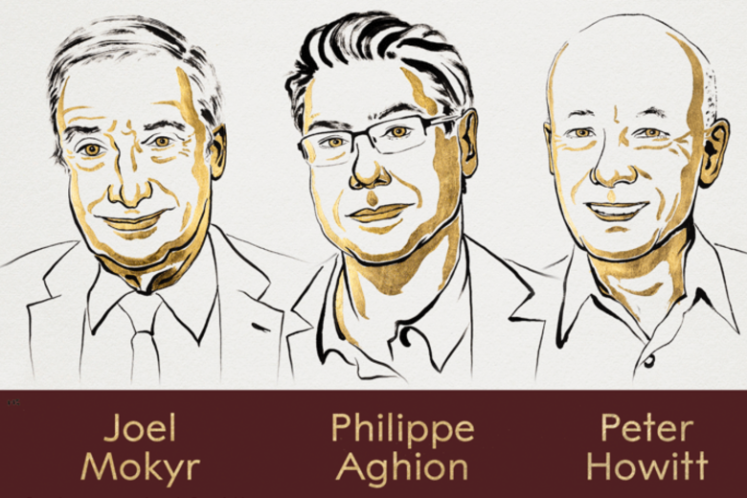
Innovation Spotlight: 2025 Nobel Prize in Economics
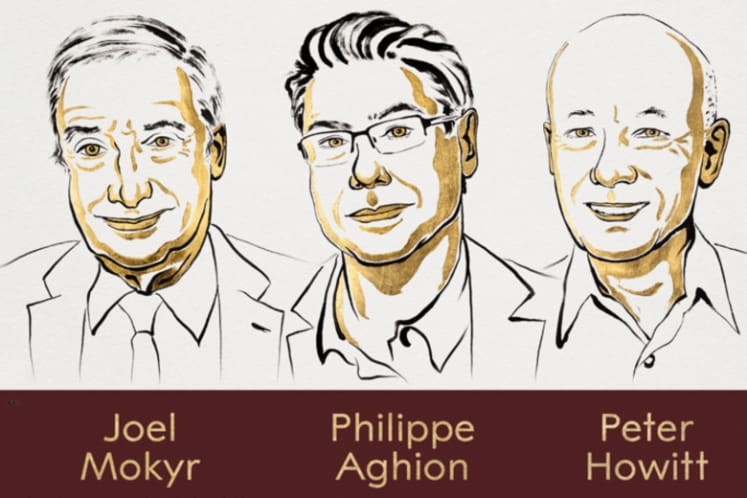
source: Niklas Elmehed, Nobel Prize Outreach
The 2025 Nobel Prize in Economic Sciences recognised groundbreaking work on the foundations of sustained economic growth. Joel Mokyr identified the prerequisites for sustained growth through technological progress, while Philippe Aghion and Peter Howitt developed the theory of sustained growth through creative destruction. Though their approaches differ, all three illuminated why nations have grown at varying speeds since the Industrial Revolution.
As the European Central Bank (ECB) noted, these economists address “some of the biggest questions an economist can ask... How can countries not only achieve economic prosperity, but maintain it?” Their insights are crucial not only for Europe but for Australia as well. The theory of creative destruction reveals that innovation both drives growth and generates the economic churn that comes from new technologies replacing the old. Innovation builds upon expanding knowledge, evolving processes, and continuous improvements in quality—forming the backbone of sustainable growth.
Technology enhances efficiency, health, and education, but in an innovation-driven economy, the central contest becomes who innovates best—not who owns, charges, or controls the most. Barriers to innovation remain, however. Research and development (R&D) in Australia is concentrated within large corporations and select industries, with limited government support. In 2021–22, R&D spending accounted for less than 1.7% of GDP, well below the OECD average of 2.7% (1).
While public investment can help, it is equally vital that businesses, organisations, and individuals understand why innovation matters. As the ECB observes, both governments and citizens often take recent economic progress for granted. When crafting policy for creative destruction, the balance is delicate: patents and regulation must support fair innovation without stifling it; competition must remain healthy to prevent monopolies that slow progress.
Creative destruction inevitably causes disruption; shifts in workforce demand, adaptation to new technologies, and evolving ways of working. This turbulence, though uncomfortable, is essential for sustained growth. The ECB reminds us that such dynamism fuels long-term prosperity. Australia possesses the talent, institutions, and ingenuity required for sustained growth. What remains is alignment; ensuring that policy, capital, and culture move deliberately in the same direction.
The Era of Dark Passions — David Brooks, The New York Times, 18th September 2025
In “The Era of Dark Passions,” David Brooks explores how our sources of motivation have shifted, from bright passions such as hope, aspiration, and faith in a better future to dark passions rooted in hate, fear, and resentment. He argues that this transformation has reshaped political leadership. Dark passions are potent, especially in the short term, but they narrow our focus to immediate fears rather than long-term vision. They burn hot and fast, unsustainable, volatile, and easily manipulated.
Importantly, Brooks doesn’t condemn these emotions as inherently bad. Rather, he cautions against those who weaponize them - stoking hatred, fear, and resentment for political or personal power. The decline of shared moral frameworks, including religion, has weakened our collective capacity to rally around bright passions. While religion’s history is complex, Brooks’ broader point holds: without a shared ethical anchor, society becomes more susceptible to manipulation by dark motivations.
Bright passions, by contrast, are sustainable because they are built on belief in the future. In an age when media often amplifies fear, seeking motivation through hope is demanding but necessary. As The Hunger Games reminds us, “hope is the only thing stronger than fear.” Dark passions may dominate headlines and win elections, but only bright passions can sustain a society.
Brooks warns that humiliation, another dark passion, has been just as destructive as fear, often serving as the spark for conflict. History provides sobering examples: Germany after World War I, Russia after the Cold War. “Humiliation drives world events,” Brooks writes, calling for conscious restraint against this cycle.
The antidote lies in those who choose light over darkness. Brooks points to individuals who, even in moments of devastation, embodied bright passions: Martin Luther King Jr. in the civil rights movement, Viktor Frankl during the Holocaust, Anne Frank through her writing, and Václav Havel under authoritarian rule. Each faced unimaginable hardship yet continued to hope, and in doing so, inspired others.
Their stories remind us that both light and dark are enduring human forces. We cannot eliminate darkness, but we can choose where to dwell. Dark passions can mobilise crowds, but only bright passions can build a civilisation worth sustaining.