The Ambition Deficit
Build Australia goes public, six years of wage growth goes missing, and the case for sourcing policy from the country's most ambitious rather than its most credentialled
Good evening, reader.
Editor's note: This week a movement of builders filed its papers with the public. Build Australia, founded by Eucalyptus co-founder Charlie Gearside, has gone public with a proposition this newsletter has circled for months: that a country's policy should be drawn from the experience of its most ambitious people, not from the institutional career pipeline that currently supplies it.
In today's Innovation Commons:
Build Australia has gone public: a coming out party in Sydney, bold ideas pitched from a stage, and a bid to make patriotism mean capability again (Capital Brief).
The numbers behind the mood: Australian real wages fell 4.8 per cent below their pre-pandemic level by mid-2024, one of the largest drops in the OECD, while the OECD average rose 1.5 per cent (OECD Employment Outlook, via the University of Sydney); the OECD's January survey finds real household disposable income per capita still at its 2019 level (OECD Economic Surveys: Australia 2026). Six years for nothing.
The argument: a country gets the policy of the people it sources policy from, and Australia sources its policy from a career pipeline that has never built anything.
The falsification test, and what Build Australia has to do to matter.
Six years for nothing
By mid-2024, Australian real wages sat 4.8 per cent below where they stood just before the pandemic, one of the largest falls in the OECD, over a period in which the OECD average rose 1.5 per cent. The University of Sydney's John Buchanan noted that on the severity of real pay cuts for the low paid, Australia had joined the company of Lithuania, Estonia and Hungary. The recovery since has been a crawl: the OECD's January 2026 survey of Australia finds real household disposable income per capita has clawed its way back to its 2019 level, and no further, while its March wage bulletin lists Australia among only six OECD countries where the real minimum wage fell over the year to January.
The standard Australian household has spent six years running to stand still, in one of the richest countries on earth, through a global recovery its peers participated in. The laurels are real: three decades without a recession, world-class institutions, enviable rocks. But resting on them is no longer a metaphor. It is a measurable position on an OECD chart, and the chart is flat.
The builders go public
In May, under the dim glow of a prop phone booth at a Sydney event space, Eucalyptus co-founder Charlie Gearside launched what Capital Brief called a hearts and minds, vibes-based movement. Speakers, Gearside among them alongside Co Ventures general partner Maxine Minter and podcaster Joe Walker, pitched bold ideas for the country from a stage, and the room was told that patriotism is not a dirty word. Gearside's credentials for the pulpit are the point: he spent six years co-founding and scaling Eucalyptus into one of the world's larger telehealth companies, valued around $560 million, then stepped back in 2024 to spend his time arguing that Australia is in a deep malaise and can be the best at things again. His budget response distilled the program to a sentence: back the risk-takers building future prosperity rather than taxing ambition out of existence.
Context matters here. This has been a year in which the word movement, in Australia, has mostly meant marches about who belongs in the country. Build Australia's wager runs the other way: it plants the flag on what the country can make rather than on who it can exclude, and it recruits from the people who have made things. A vibes-based movement is easy to dismiss, and the dismissal writes itself. We read it differently: as the first organised attempt in years to fix the supply side of a problem this newsletter keeps finding on the demand side.
Who writes the policy
A country gets the policy of the people it sources policy from. Australia sources its economic and industry policy from a pipeline of remarkable consistency: a good school, a sandstone degree, a graduate program, then decades inside a department, a ministerial office or a consultancy, with seniority accruing to tenure and process fluency. This is not our diagnosis alone. The Thodey review, the most substantial examination of the public service in forty years, found an institution ill prepared for the decades ahead and too closed to outside experience, and it said so in 2019, before the wage line above went flat. The pipeline selects for credential accumulation and risk avoidance, and it selects out almost everyone who has carried payroll risk, shipped a product, priced anything, or been repriced by a market. This is not a character critique. As we argued last edition, people behave rationally inside the incentive structures they are handed. It is a sourcing critique, and it shows in instruments that buy proof instead of products.
A country that sources its policy from people who have never built anything will get policy for a country that no longer builds anything.
The sourcing critique in one sentence
The record shows what each sourcing model produces, because Australia has run both experiments at full scale. Run the pipeline pure and you get Robodebt: a debt scheme designed and defended entirely inside the bubble, which the royal commission found "neither fair nor legal", devised without regard to the law it was administering, and kept running for years after public servants were warned. It unlawfully raised $1.76 billion against 433,000 people before contact with reality stopped it. Nobody who had ever sat on the receiving end of an automated invoice, or had to keep a customer, would have shipped it. Run the other model and you get the Snowy. In 1949, asked for three candidates to lead the largest thing this country would ever build, the responsible minister handed Chifley a note that read "Hudson, Hudson, Hudson". William Hudson was a 53-year-old dam engineer recruited from outside the service, given sweeping authority and direct access to his minister, and he delivered an engineering wonder of the world with a workforce of 100,000 drawn from more than thirty countries, under budget and ahead of time. The pen, handed to a builder, built.
The counterargument deserves its due. Institutional knowledge, probity and continuity are real assets; nobody serious proposes replacing Treasury with a founders' WhatsApp group, and the Snowy needed the state's patience as much as Hudson's nerve. The claim is narrower and sharper: at the levels where policy is designed, the experience base should include people whose careers were spent under consequence. Thodey recommended opening the service to outside talent seven years ago. The builder's path into policy still runs through the stakeholder submission and the consultation roundtable, rooms where the people who have done the thing are consulted by the people who will write it down, and never handed the pen.
Which is the standard Build Australia should be held to, and by its own logic will invite. Hearts and minds are the entry fee. The measure of the movement is conversion, and conversion has a scoreboard: drafted instruments a minister could table, costed proposals a department has to answer, and people. Within two electoral cycles the test is whether Build Australia has put builders into preselections, onto ministerial staffs and into deputy secretary chairs, so that the career bubble has to compete for the pen rather than inheriting it. The pilot economy taught us what happens to enthusiasm without a conversion mechanism. Movements are not exempt.
This reading comes with a falsification test. Name five people in the top two levels of the departments that set Australia's economic and industry policy who have founded, built or operated an enterprise that had to meet a payroll. If the names come easily, this piece is wrong, and happily so. If the room goes quiet, the sourcing critique stands, and the flat line in the first section is what it costs.
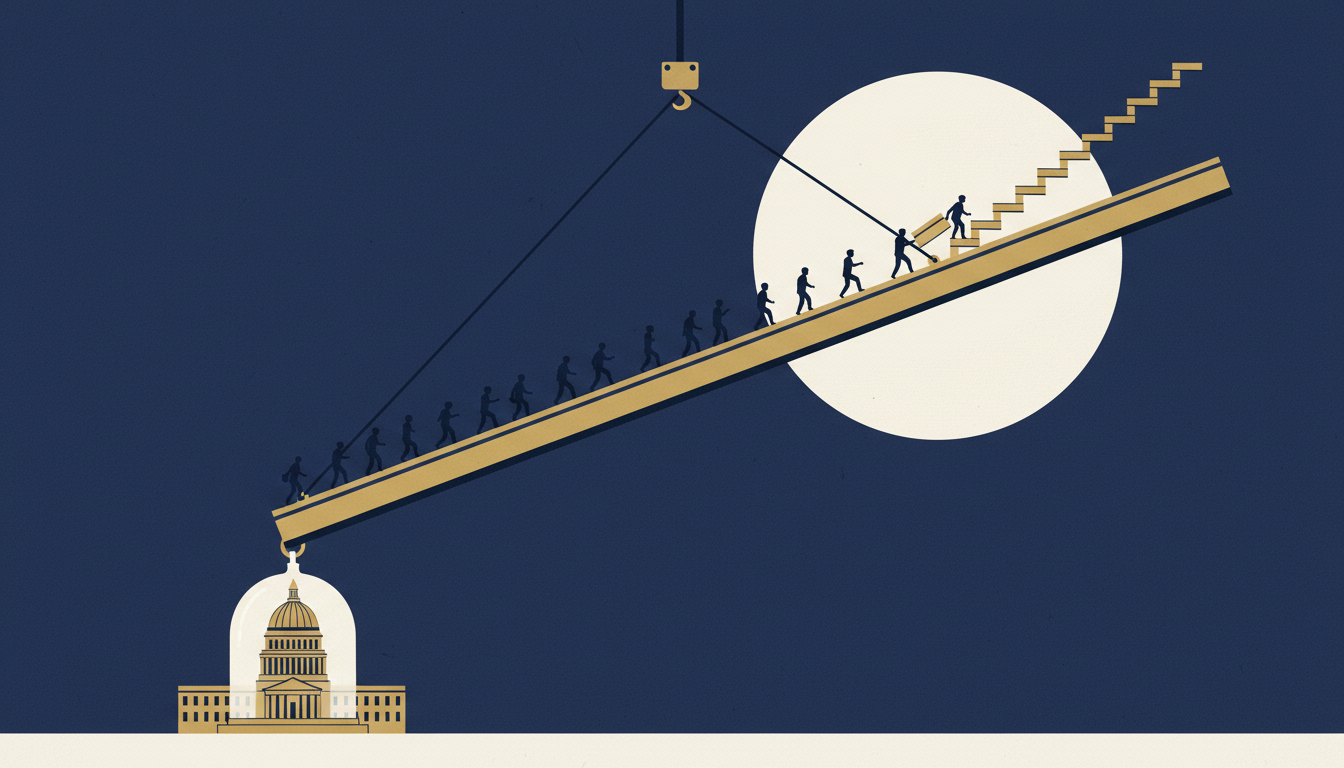
The parliament in this week's illustration sits under glass, on a line that has not moved in six years. Beside it, the ascent is being stacked by hand. The builders have now asked their question in public, and it is a simple one: who does this country let hold the pen.
— The Editor
P.S. Share this on LinkedIn/X to spark conversations with your colleagues.