The Firm Is The Trace
When AI agents become the org chart, the asset that matters is the record of every decision they make.
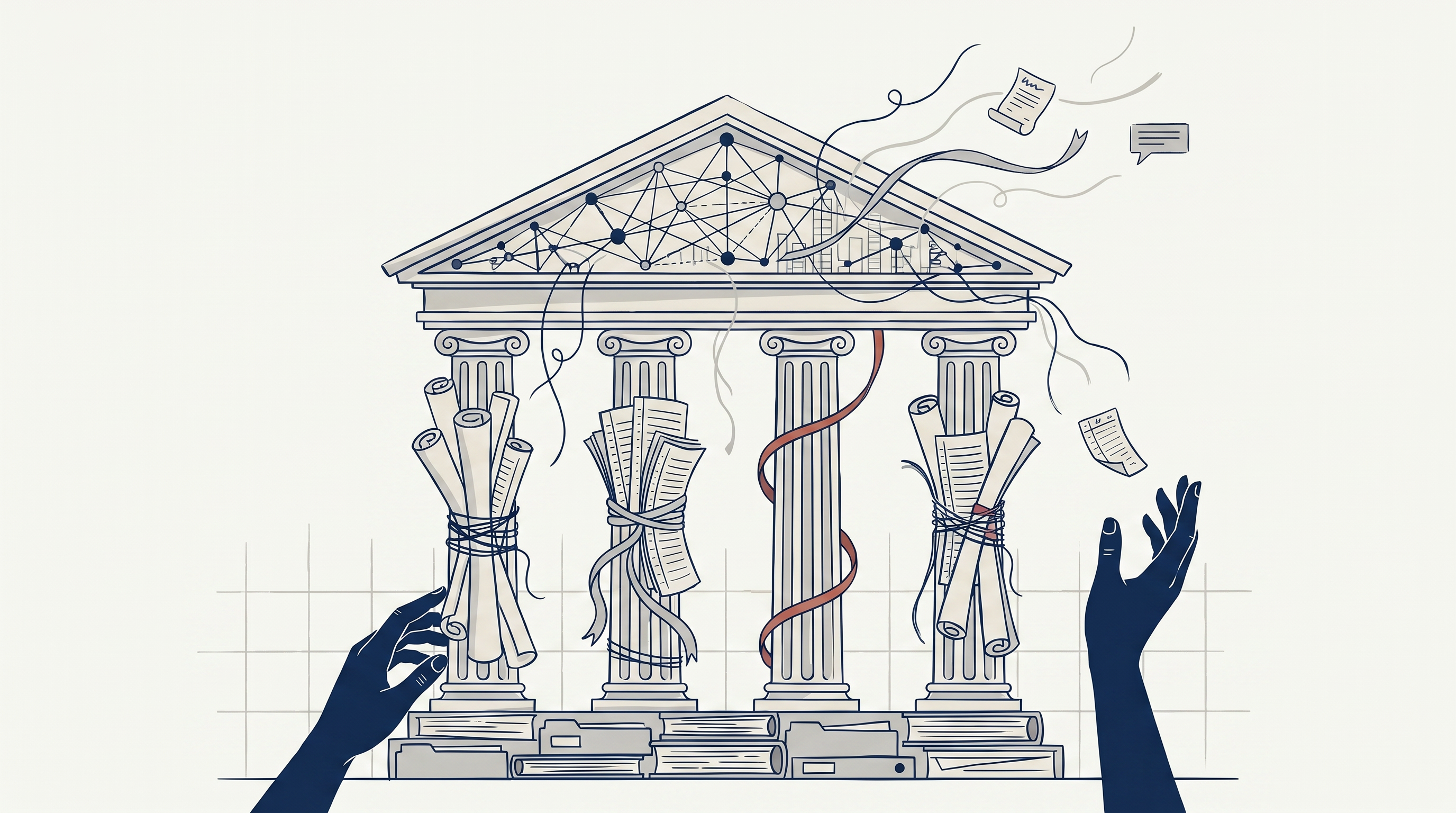
Two arguments landed within a week of each other in early 2026, and together they describe a structural shift Australia is not yet equipped to capture. Block, in a piece co-signed by Jack Dorsey and Roelof Botha, has declared it is rebuilding itself as "a company organised as an intelligence rather than a hierarchy" replacing middle management with a model that coordinates work directly1.
Foundation Capital, in the same fortnight, has named the asset that makes such a firm possible: the context graph, "a living record of decision traces stitched across entities and time so precedent becomes searchable", and called it "the single most valuable asset for companies in the era of AI"2. Read together, they describe one thing, not two. The firm of the next decade is not flatter. It is built on a substrate that has never existed before. The question for Australia is whether we own that substrate or rent it.
Block's argument is structural. Hierarchy, they write, is "an information routing protocol built around a simple human limitation: a leader can effectively manage somewhere between three and eight people." Two thousand years of organisational design, Roman cohorts, Prussian general staffs, modern corporate matrices, were workarounds for a constraint that had never been broken.
Block claims AI breaks it. Their proposed structure has three roles: individual contributors who build capabilities and the model itself; directly responsible individuals who own cross-cutting outcomes for fixed terms; and player-coaches who develop people while still doing the work. No permanent middle management.
The "intelligence layer" composes solutions (a small-business loan, a savings goal, a card upgrade) at the moment a customer's behaviour signals the need, before any product manager files a ticket. "Customer reality generates the backlog directly." The edge is empowered. The intelligence lives in the system.
Foundation Capital's argument is economic. The last generation of enterprise software became a trillion-dollar industry by capturing systems of record: Salesforce for accounts, Workday for people, ServiceNow for tickets.
Those systems captured the what. They never captured the why: the exception logic in a deal desk lead's head, the precedent from last quarter's negotiation, the VP approval that happened on Slack and never made it into the CRM.
AI agents that sit "in the execution path" of a workflow can finally capture all of it every input gathered, every policy invoked, every override approved, every cross-system signal that informed the call. Foundation calls the resulting artefact a context graph and argues that the next trillion-dollar platforms will be built on it.
Not on adding AI to existing data, but on capturing the decision traces that make data actionable in the first place.
The pieces interlock. Block describes the shape of the firm. Foundation describes its substrate. A company organised as an intelligence cannot exist without a context graph: because without a continuously updated record of how decisions were made, the intelligence layer has nothing to learn from and the edge has no shared truth to act against. Block names the architecture; Foundation names the asset that makes the architecture run.
What is actually being proposed
It is worth being precise about what Block is and is not claiming. They are not announcing the elimination of management, nor a flattening of reporting lines into chaos. The piece is co-signed by a sitting CEO and a venture investor, not a manifesto writer.
What they are proposing is that the function middle management performed: routing information, pre-computing decisions, maintaining alignment across silos; can now be performed by a system that maintains a continuously updated model of the entire business.
The Prussian General Staff, they note, was "middle management before the term existed. Professionals whose purpose was to route information, pre-compute decisions, and maintain alignment across a complex organisation."
That role can be automated. The remaining human roles (building capabilities, owning outcomes, developing people, applying judgement in novel situations) cannot.
What Foundation is proposing is the storage layer that makes Block's claim coherent. A company world model is only as good as the data it can synthesise. Today, a Salesforce record will tell you a renewal closed at a 20 per cent discount.
It will not tell you that the discount was approved because of three SEV-1 incidents in the previous quarter, an open "cancel unless fixed" escalation in Zendesk, and a precedent set by a similar deal with a healthcare customer six months ago.
Those four signals existed in four different systems and a fifth, the VP's verbal approval, existed nowhere. The decision was made anyway, by a human who held the context in her head. When that human leaves, the context leaves with her.
The context graph is the proposal that AI agents executing the workflow can capture this reasoning at decision time and persist it as a first-class record.
Why the two arguments are the same argument
The conventional reading is that Block's piece is about firms and Foundation's is about software. That reading misses what makes the synthesis powerful.
A firm organised as an intelligence is, operationally, a context graph that has acquired a balance sheet. The economic graph Block describes, millions of merchants and consumers, both sides of every transaction, financial behaviour observed in real time — is itself a context graph.
The decision traces are the transactions; the connections are the relationships between merchants and customers; the "why" is the customer state model that Block says drives proactive solution composition. Block has spent fifteen years building the substrate. The 2026 essay is the moment they are explicitly naming what they have, and what kind of firm it lets them be.
This is also why the trillion-dollar claim is not hyperbolic. The previous generation of enterprise software was valued at a trillion dollars because every meaningful business process was forced to leave a record in a system somewhere and whoever owned the system owned the data, the workflow, and the customer relationship.
The next generation extends that logic to the reasoning layer. If the firm becomes a context graph, then the value of the firm is the value of the graph. Whoever owns the orchestration layer owns the traces. Whoever owns the traces owns the precedent. Whoever owns the precedent owns the future of how that decision is made at every comparable firm, in every comparable industry, for as long as the graph keeps growing.
What this means for Australia
Two observations follow.
The first is this is not a problem of capability. Australia has the engineers and the AI talent to build this layer, but of stance. The trillion-dollar opportunity Foundation describes is structurally hostile to incumbents. Salesforce Agentforce, ServiceNow Now Assist, Workday HR agents, all are constrained to read state from their own system.
They cannot sit in the orchestration path across systems. Snowflake Cortex and Databricks AgentBricks read decisions after the fact via ETL.
They cannot tell you why. The structural advantage belongs to the firms that build the agent orchestration layer fresh, on top of existing systems of record, capturing the traces the incumbents will never capture and never be allowed to.
Australian incumbents that already lead in vertical software (Atlassian, Xero, WiseTech) have the rare opportunity to build this layer for themselves rather than be disintermediated by it.
Whether they do is a question of whether they treat it as a software roadmap item or as a question about what their firm fundamentally is.
The second, and this is the one that matters for policy: a firm built on a context graph is a firm whose competitive moat is institutional knowledge made queryable.
That is a public-policy concept dressed in software clothing. Australia's productivity malaise (flat output per worker since 2020, R&D below the OECD average, exports concentrated in commodities and education) is at root a problem of how slowly institutional knowledge moves between firms, between universities, and between sectors. The context graph is, among other things, a technology for compressing that movement from years to seconds.
A regulatory and procurement environment that recognises this, that allows agentic systems to operate in the orchestration path of healthcare, financial services, and government, with appropriate provenance and auditability, would do more for productivity than any tax incentive.
A regulatory environment that treats every AI agent as a privacy or liability hazard to be siloed will guarantee that Australia rents its context graphs from US firms, and pays the rent in the form of permanent productivity drag.
What to watch in the next twelve months
Three signals will tell us whether the synthesis is real or whether 2026 is the year both pieces are quoted often and understood little.
Signal one is whether Block actually publishes evidence of the operating model in production. Roadmap-from-failure-signal is a distinctive enough claim that it should be visible in product release patterns within twelve months. If the products Block ships in 2027 look indistinguishable from the products Block shipped in 2024, the framework is rhetoric. If they look like surprising compositions of pre-existing capabilities — appearing in customers' lives before the customer asked — the framework is real.
Signal two is whether Foundation's portfolio companies — and their non-portfolio competitors — start publishing context graph schemas. The systems-of-record generation became valuable in part because their data models were public, queryable, and integrable. A context graph that is private, opaque, and lock-in-only will struggle to capture the aggregate value Foundation is forecasting. Watch for the first open context graph specification. The firm that publishes it will define the layer.
Signal three, for Australia, is whether the next twelve months produces a single Australian agent-native firm that explicitly positions on decision-trace capture as the thesis. Not "AI in the workflow" — every vendor is now saying that. Specifically: "we sit in the orchestration path, we persist the traces, we own the graph." If we end 2026 without that firm visible in Australia, the trillion-dollar opportunity has been ceded by inattention.
1 Dorsey, Jack and Botha, Roelof. From Hierarchy to Intelligence: how Block is using AI to eliminate hierarchical bottlenecks. Block, 2026. block.xyz/inside/from-hierarchy-to-intelligence
2 Gupta, Jaya and Garg, Ashu. Context Graphs: AI's trillion-dollar opportunity. Foundation Capital Ideas, April 2026. foundationcapital.com/ideas/context-graphs-ais-trillion-dollar-opportunity