The Froth That Built The World
The bubbles from Broken Hill that were strong enough to rest modern civilisation
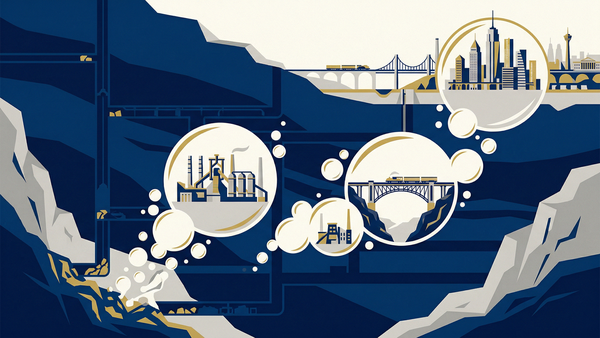
Editor's note: Everyone knows Wi-Fi came from the CSIRO. Fewer people know that another Australian innovation (born not in a lab but in the red dust of outback New South Wales) made possible the extraction of virtually every metal in the modern economy. We look at the quiet revolution that started with a problem no one could solve, and a solution no one expected.
Innovation Spotlight: Froth Flotation
Walk into any room you are sitting in and look around. The copper in the wiring. The zinc in the galvanised roof. The lead in the old pipes. The lithium in the phone in your pocket. The rare earths in the magnets of your laptop speakers. Every one of these metals, at some point in its journey from rock to refined product, almost certainly passed through a froth flotation cell.
Today, more than two billion tonnes of ore and coal are processed annually using froth flotation worldwide. An estimated 85% of all non-ferrous metals are recovered through some variant of this process. It is, by many assessments, the single most important development in twentieth-century mining. And it was born in Broken Hill.
The Sulphide Problem
By the 1890s, the mines at Broken Hill had a crisis. The rich silver-lead carbonate ores near the surface, the easy stuff, were running out. Beneath them lay enormous deposits of sulphide ore, in which lead, zinc, and silver were locked together in an intimate, stubborn embrace with waste rock. Gravity separation, the standard method of the day, could pull out some of the lead. But the zinc? It slipped through. By 1904, an estimated 6.5 million tonnes of zinc-rich tailings had been dumped in great grey mountains beside the mines, considered worthless.
The mining press called it "the sulphide problem," and it was not academic. Without a solution, Broken Hill's future (and much of Australia's early industrial economy!) would stall. The zinc locked in those tailings was worth a fortune, if only someone could figure out how to get it out.
Bubbles and Stubbornness
The insight, when it came, was almost absurdly elegant.
In 1902, Charles Potter1 , a Melbourne analytical chemist, patented a process that used acid to generate gas bubbles on the surface of sulphide mineral particles, causing them to rise to the surface of a liquid bath while the waste rock sank. Guillaume Delprat, General Manager of BHP at Broken Hill, independently developed a similar method using salt-cake. Litigation followed (this was, after all, a mining town) but the principle had been established: you could make valuable minerals float.
The real breakthrough came in 1905, when engineers at Minerals Separation Ltd perfected a variation at Broken Hill that used violent mechanical agitation with a small amount of oil to produce a persistent froth. Sulphide minerals, naturally hydrophobic, attached themselves to the air bubbles and rose to the surface in a dirty, mineral-rich foam. The waste sank. The process was selective, scalable, and transformative.
Within a decade, those 6.5 million tonnes of "worthless" tailings had disappeared back underground — reprocessed and stripped of their zinc. The mountains vanished. By 1914, forty-two American mining companies had adopted froth flotation. By the 1930s, it had opened the extraction of twenty-four metallic and nineteen non-metallic ores that had previously been uneconomical. Almost overnight, the global mining industry shifted from chasing diminishing high-grade deposits to unlocking the vast, low-grade ore bodies that make up the overwhelming majority of the earth's mineral wealth.
Why It Matters Now
Froth flotation did not merely solve a local problem in western New South Wales. It restructured the economics of metal production worldwide. Without it, copper would have become increasingly costly and scarce well before the electrical age reached full stride. Without it, the zinc, lead, nickel, and phosphate industries that underpin construction, agriculture, and manufacturing would look radically different. Without it, the critical minerals driving the current energy transition - lithium, cobalt, rare earth elements - would remain largely locked in low-grade rock, technically present but economically inaccessible.
The global flotation reagents market alone was valued at US$5.56 billion in 2024, projected to reach $7.53 billion by 2030 — a figure that captures only the chemicals, not the equipment, infrastructure, or the trillions of dollars in metals that pass through flotation circuits each year. The process has been adapted for wastewater treatment, paper recycling, and industrial separation. It is, in every sense, a foundational technology: one so deeply embedded in the architecture of production that it has become invisible.
The Mark of Real Innovation
There is a pattern in Australian innovation that deserves more attention. Wi-Fi, atomic absorption spectroscopy, polymer banknotes, the shipping container's precursors — the breakthroughs that matter most tend to be the ones you stop noticing. They do not announce themselves. They become infrastructure.
Froth flotation fits this pattern perfectly. It was not the product of a single genius in a garage. It emerged from a specific, urgent, local problem: the sulphide crisis at Broken Hill; and was solved through iterative experimentation by chemists, engineers, and mining companies working in parallel, borrowing from each other, litigating against each other, and slowly refining an idea that none of them fully understood at first. It was messy, contested, and collaborative. It was, in other words, how real innovation usually works.
Broken Hill is sometimes called "the home of flotation." The phrase is modest, almost self-effacing, in the way that consequential Australian things often are. But it is not an exaggeration. The technique that emerged from those dusty tailings dumps in outback New South Wales went on to underwrite the material basis of modern industrial life. Every building, every circuit board, every bridge and battery and power line owes something to the simple, improbable idea that you could make rock float!
P.S. Broken Hill gave Australia more than flotation; BHP itself, the country's iron and steel industry, and some of the earliest examples of organised labour rights all trace their origins to the same few square kilometres of red earth. A place worth remembering. More on this in future editions.
1: No relation to Harry