The Orchestra in a Green Box
Stevie Wonder, Kate Bush, Page R, and the second life in post-production
Editor's note: I have been thinking about this piece for a while, and what kept stopping me was the worry that it would read as a list. The Fairlight CMI is the kind of subject that invites lists. The artists who used it: the list. The records it shaped: the list. The features it pioneered: the list. The lists are correct and they are also boring. They turn a particular Sydney workshop and two particular young men in their twenties into a Wikipedia entry. What I wanted to write was the story underneath the list - the story of how a failed attempt to do one thing produced, almost by accident, the thing that everyone now does. So that is what this is. There are still some lists. I have tried to keep them short.
Good evening, reader.
In today's Innovation Commons: a hydrofoil, a green-on-black screen, a light pen, a teenager who could not get the sound he wanted, a Motorola consulting engineer who built a synthesiser with help from the Canberra School of Music, a sample of breaking glass, a sample of Stravinsky's "Firebird" that became the most over-used pop noise of the 1990s, a record made almost entirely from one preset, a bankruptcy, and a quiet second life in post-production that nobody outside the trade knows about.
Let's get into it.
The hydrofoil that gave the company its name
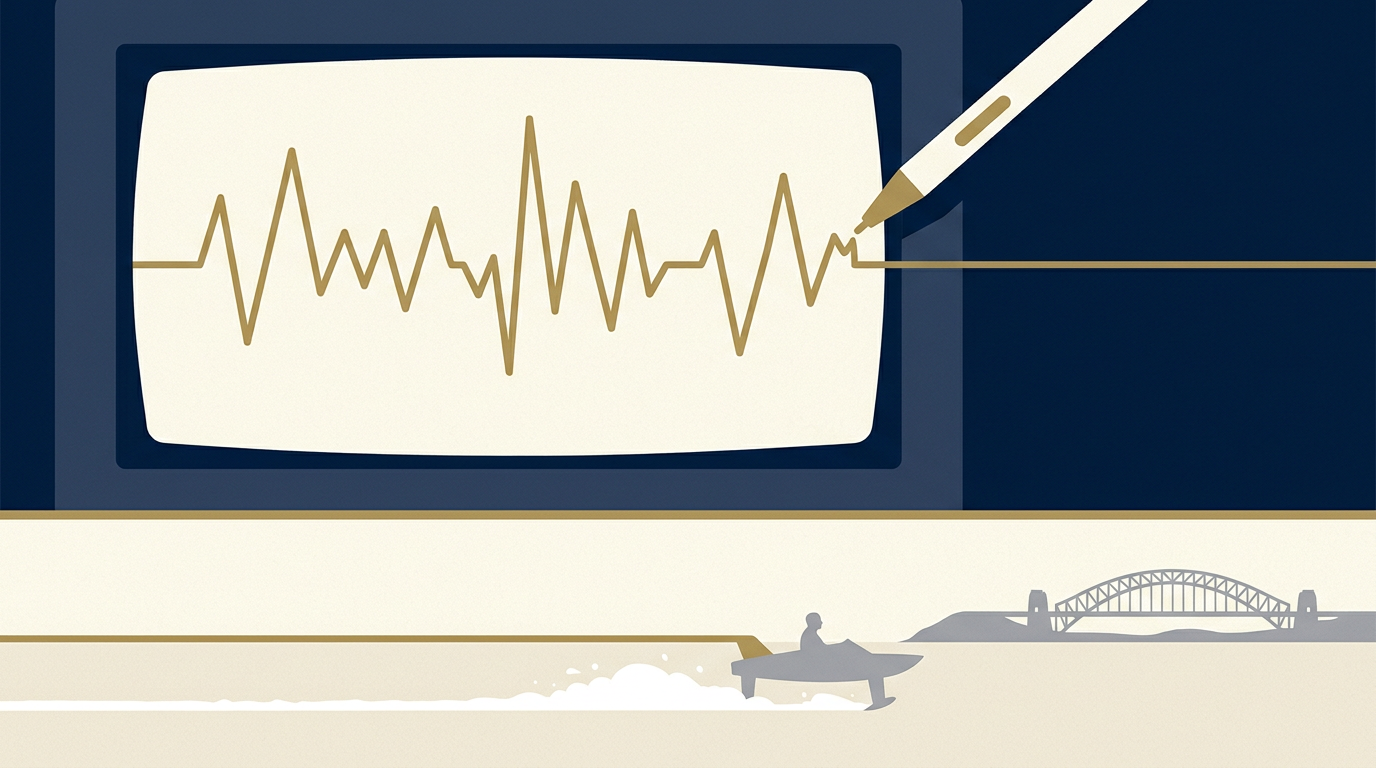
The Fairlight was a hydrofoil. It carried commuters across Sydney Harbour from Circular Quay to Manly, lifting out of the water once it had enough speed and skimming above the chop. From Kim Ryrie's grandmother's house at Point Piper you could watch it go past. In December 1975 Ryrie and his old school friend Peter Vogel decided to form a company to build a digital synthesiser, and they needed a name. The hydrofoil was outside the window. They called the company Fairlight.
Both of them were in their early twenties. Ryrie had started a magazine, Electronics Today International, while still at school, and had published the circuit diagrams for two build-it-yourself analogue synthesisers, the ETI 3600 and the ETI 4600. He was frustrated by what the kits could actually do. The sounds were thin. The control was clumsy. As he put it later, he wanted to build "the world's greatest synthesiser", and he wanted Vogel to help him do it. Vogel had had a short go at university, decided it was not for him, and agreed.
They worked in Ryrie's grandmother's garage, overlooking the same stretch of water the hydrofoil crossed. They had no marketing department, no investors, no factory, and almost no money. What they did have was a clear idea of what was missing in synthesised sound (the warmth and the strangeness of acoustic instruments) and a willingness to spend several years failing to get it (Peter Vogel Instruments, 120 Years of Electronic Music).
The Canberra engineer they could not have done it without
The unsung figure in the Fairlight story is Tony Furse. Furse was a consulting engineer for Motorola, based in Sydney, who in the early 1970s had begun building digital synthesisers of his own. In 1972 and 1973, with backing from the Australian Federal Government and from the composer Don Banks at the Canberra School of Music, he developed the Qasar I and Qasar II, hybrid analogue-and-digital instruments. In 1975 he completed the Qasar M8 (Multimode 😎 a fully digital, eight-voice polyphonic synthesiser built around two Motorola 6800 microprocessors running in an unusual parallel configuration. It had a light pen for drawing waveforms on a black-and-white screen, an eight-inch floppy drive, and additive synthesis using fast Fourier transforms. It cost about fifteen thousand 1975 Australian dollars and almost nobody bought one (120 Years of Electronic Music, Out Of Phase).
What it did have was processing power. Two 6800s running in parallel was a lot of computer for 1975, especially at the price. In 1976 Ryrie and Vogel approached Furse to license the M8. They paid for the right to redesign the instrument with printed circuit boards rather than hand-wired ones, a longer keyboard, and a new operating system called QDOS, adapted from Motorola's MDOS. They called the result the Qasar M8 CMI, Computer Musical Instrument. It was huge, expensive, and unmarketable. Ryrie now refers to it as "a research design". A small piece of trade history that is worth holding onto: the architecture that would later define digital music came out of a federally funded music research collaboration in Canberra, and was developed commercially in a garage in Point Piper. There was no Silicon Valley round of financing. There was Tony Furse, a magazine publisher's grandmother's garage, and an Australia Council grant (Australian National University research record).
The accident that became the product
By 1978 Ryrie and Vogel were not getting where they wanted to go. The original plan had been physical modelling, to digitally synthesise a sound that imitated the actual physics of a violin, or a flute, or a clarinet. The Qasar M8 CMI could make sounds. The sounds were odd. They were not convincingly like real instruments. The pair were running out of money and out of patience.
Vogel tried something else. He recorded a second or so of a piano piece off the radio, loaded it into the machine's memory, and played it back through the keyboard at different pitches. It sounded, to his ear, more like a piano than anything they had managed to synthesise from scratch. They both regarded this as a kind of defeat. It was not really synthesis. It was a recording being shifted around. Ryrie has been candid about this in later interviews. "We regarded using recorded real-life sounds as a compromise, as cheating, and we didn't feel particularly proud of it." They needed something to sell, so they sold it anyway. They coined a word for what they were doing: sampling. They had no idea, at that point, that they had just invented the central technique of forty years of recorded music (Sound On Sound, 1987 interview with Kim Ryrie, anerd.com archive of Peter Vogel's "Fairlight: The Whole Story").
The first commercial Fairlight CMI shipped in 1979. It had eight-voice polyphony, a 73-note keyboard, a QWERTY keyboard, a green-on-black monitor, a light pen for drawing waveforms directly on the screen, two eight-inch floppy drives, and sixteen kilobytes of sample memory per voice. The maximum sample length was about a second, at a sample rate of around 24 kilohertz. By any contemporary standard the sound quality was poor. The aliasing was obvious. The character was unmistakeable (Vintage Synth Explorer, Museums Victoria Collections).
The first customer was Stevie Wonder
There is no good way to describe how strange this part of the story is. Vogel flew to the United States in 1979 with one Fairlight CMI in tow and somehow secured a demonstration for Stevie Wonder. Wonder bought it on the spot. That was the company's first sale. The instrument cost around twenty-five thousand US dollars, which in 1979 was roughly the price of a small house (Sound On Sound, Rolling Stone Australia).
Word spread. In the summer of 1979 Vogel took another machine to Peter Gabriel's house in Box, near Bath in Somerset, where Gabriel was recording his third solo album. The producers Hugh Padgham and Steve Lillywhite were there. Stephen Paine, a friend of Gabriel's, was there. Vogel stayed for a week. Gabriel used the machine on the album more or less immediately, sampling breaking milk bottles and bricks being hit and incorporating them into the rhythm tracks. He liked it so much he co-founded a company, Syco Systems, with Paine, specifically to import Fairlights into the United Kingdom. Their second customer was John Paul Jones, the bass player from Led Zeppelin, who wanted to retire his Mellotron. Kate Bush bought one. Trevor Horn bought one, for £18,000, he later said, when there were only four in the country. Thomas Dolby, Stewart Copeland, Geoff Downes, Richard Burgess, Alan Parsons, Rick Wright, Jan Hammer, Herbie Hancock, Todd Rundgren, Joni Mitchell. Quincy Jones, after Hancock showed him one. Brian Eno. Annie Lennox. The Pet Shop Boys. Frankie Goes to Hollywood. The Art of Noise as an entire group. By the mid-1980s, if you were producing a record that was going to be heard on the radio, the Fairlight was either in your studio or in the studio next door (Out Of Phase, Tape Op interview with Trevor Horn, Electricity Club: Trevor Horn).
About 300 CMIs were ever built across all series. That is roughly one machine for every two countries on Earth. Each one of them shipped to a recording studio belonging to someone whose name you know. It is one of the most concentrated technological footprints in the history of any consumer product. The reason almost no Australians can tell you any of this is that the machines never came home in any quantity. The artists who owned them were on the other side of the planet, mostly in London and Los Angeles. The records the Fairlights made were the soundtrack of the 1980s. The country that made the Fairlights got to listen to those records on the radio like everyone else, without realising who had built the thing the records were coming out of.
Page R, and a quiet revolution that nobody outside the trade noticed
The first Fairlight CMI had a sequencer of sorts. It was called MCL, the Music Composition Language. It was a kind of programming language for music, and almost nobody could be bothered to learn it. In 1982 the company released the Series II, and the Series II contained something called Page R. Page R was a graphical sequencer. You looked at it on the green-on-black screen and you saw horizontal tracks running left to right, each one carrying a pattern of notes. You could quantise. You could loop. You could add and remove sounds from a pattern with the light pen. You could chain patterns into a song. It was, in retrospect, the first commercially available digital audio workstation in something close to the form we still use today. Every sequencer that has been written since (Logic, Cubase, Pro Tools, Ableton Live, every drum machine in every phone app, every step sequencer on every Eurorack module) is a descendant of Page R, and most of them are direct descendants of the visual metaphor Page R established. Stephen Paine put it this way: "Nowadays all sequencers work in a similar way to Page R, but at the time, it was a phenomenally original idea, and people just went nuts over it. There were people who bought the Fairlight from us purely because of that facility." (Sound On Sound, Science and Media Museum, anerd.com archive).
The Series II also introduced MIDI in its IIx revision, raised the sample rate to 32 kilohertz, and added the eight-bit pre-loaded sample library that came on the floppy disks. One of those samples was a recording, made by Peter Vogel himself, of a dramatic orchestral hit from Stravinsky's "Firebird". It was filed on the disk as ORCH5, later renamed ORCH2. If you have ever heard the punchy synthesised orchestra-stab sound that punctuates almost every 1980s pop production from Afrika Bambaataa's "Planet Rock" through Yes's "Owner of a Lonely Heart" through every Bruno Mars record up to the present, that is the Fairlight. That is Igor Stravinsky, recorded once by an Australian engineer in 1982, played back at thousands of different pitches in tens of thousands of records by everyone who has ever made a pop song since. It is one of the most heard sounds in human history. Very few of the people who have heard it know what it is or where it came from (Science and Media Museum, Google Arts and Culture).
In 1985 the Series III appeared, at a list price of around £60,000. Sixteen-bit, 44.1 kilohertz, CD-quality, sixteen-voice, fourteen megabytes of RAM, a tablet rather than direct light-pen-on-screen, SMPTE time code, a redesigned sequencer called CAPS, and a completely new sound-design environment called MFX. By this point the Fairlight was less an instrument than an institution. Kate Bush wrote and recorded "Hounds of Love" on a Series II, and the single that came off it, "Running Up That Hill", is to a startling degree built around one Fairlight preset that she found on the machine and would not let go of. The song is now famous again because of "Stranger Things". The reason it sounds the way it does is largely the reason a Sydney garage decided in 1976 to make a synthesiser that ended up doing something it had not set out to do (Songs From So Deep, Reddit thread on Bush and Gabriel's Fairlight use).
There is a Stevie Wonder anecdote here that captures the era. Wonder was meant to perform at Live Aid in 1985. The Fairlight he travelled with held all the samples he intended to use. The hard drive went missing. Wonder lost his slot. The slot went to Tracy Chapman, who used it to play "Fast Car", which made her career. A whole strand of late-twentieth-century music exists, in part, because someone misplaced the hard drive of an Australian synthesiser.
The cheaper machines that ended it
The thing that killed Fairlight was not failure. It was success that had been copied by people with cheaper components. In 1985 the E-mu Emulator II shipped at a fraction of a Fairlight's price. In 1986 the Akai S900 sampler shipped at a much smaller fraction. In 1987 the S1000 followed. By that point sampling was no longer the province of the very rich. A small studio could afford to do most of what a Fairlight could do, and any studio could afford an Atari ST with Cubase or Notator and pretend, more or less convincingly, that it had a sequencer as good as Page R. Stephen Paine's Syco Systems stopped importing Fairlights into the UK in 1987. The Australian arm carried on for another year and went into receivership at the end of 1988 (anerd.com archive).
I want to be careful here, because the obvious story is wrong. It is tempting to say: the Australian company invented something brilliant, the Japanese and Americans copied it cheaper, the Australian company died, end of fable. Ryrie's own account, in interviews afterwards, is more interesting and more humbling. The CMI was still selling. A new video product the company had built called the CVI, the Computer Video Instrument (the first low-cost video graphics, effects and paint device) was selling well. A sound-design package called MFX was attracting new customers. The collapse was caused as much by a thin balance sheet, a sceptical bank, distribution mistakes in the US, and the cost of carrying the R&D for several product lines as it was by the Akais and the Atari. The company did not lose the argument. It lost the cashflow.
In April 1989, four months after receivership, Ryrie partnered with Amber Technology, a Sydney pro-audio distributor, and re-incorporated the business as Fairlight ESP: Electric Sound and Picture. Peter Vogel left to work as an independent contractor. Ryrie stayed on as Chairman and head of product development. The new company looked at its own market and made a clear-eyed decision. The high-end music market was going to be cannibalised by software running on personal computers within a few years. It was not worth fighting for. What was worth fighting for was post-production: the hard, slow, expensive work of editing dialogue and music and effects for film and television and broadcast. The Fairlight architecture, with its disk-based audio and its real-time editing and its scrollable waveform graphics, was very well suited to it. The first product, the MFX hard disk recorder, shipped later in 1989. The MFX2 followed in 1991, the MFX3 in 1994. By the mid-1990s, Fairlight had become the dominant hard-disk post-production system in the Pacific. Todd-AO, the largest post-production facility in the world, owned dozens of MFX3s. Almost every film and television sound mixer working in Tokyo, Sydney, Hong Kong and Los Angeles used a Fairlight at some point in the production chain. Most of them had no idea the company had once made musical instruments at all (Sound On Sound interview with Kim Ryrie, 1995).
A garage on Sydney Harbour, fifty years later
What I find moving about this story is not the famous-musicians part. It is the structure underneath. Two boys in their early twenties, in a garage in Point Piper, paying a fair royalty to an older engineer in Canberra for processor technology, paying their bills by selling computers to small businesses while they kept working on the synthesiser nobody had asked for. A federal government grant, channelled through the Canberra School of Music, paid for some of the underlying research. A magazine that published electronics circuits in the back pages gave Ryrie his first audience. The first customer was reached by Peter Vogel flying to the United States with one machine. There was no marketing department. There was no Series A. There was no narrative. The product was invented to do something else, accidentally did the thing the world actually wanted, and was sold to one person at a time until it was in every important recording studio on Earth.
It is worth asking what allowed this to happen here, and why it did not happen again. Some of it was the era; late 1970s electronics was cheap enough to mess with in a garage and complex enough to do something nobody else had thought of. Some of it was the institutional shape of Australian science and arts funding at the time, which paid for Tony Furse to do the difficult underlying work in Canberra and let Fairlight pick it up commercially under licence. Some of it was a publishing culture, Electronics Today International, that connected the people who knew how to build circuits to the people who wanted to. Some of it was, frankly, the geography of Sydney Harbour, which gave a young engineer in a grandmother's garage a view of a hydrofoil and a quiet enough place to spend three years failing.
Most of those conditions are still around. We still have publicly funded research. We still have garages. We still have engineers in their twenties. The piece that has thinned, by all the accounts I have read, is the patience, the willingness to spend three years on an idea that may not work, with no investor expectations, paying the bills with consulting work, before the product is good enough to put in front of one person at a time. There is no shortcut for that. The Fairlight took four years from company formation to first sale. It took another seven years before the company collapsed. It took ten years after that before its second act, in post-production, was clearly going to succeed. None of that fits inside a startup-cycle calendar.
The records remain. Every time "Running Up That Hill" comes on a radio anywhere in the world, an eight-bit sample on a green-on-black screen is being played back. Every time a pop song uses an orchestra hit on a downbeat, Igor Stravinsky's "Firebird" is being played, by way of a recording Peter Vogel made onto a Fairlight in a Sydney workshop in 1982. Every time a producer opens Ableton or Logic or FL Studio and sees a horizontal track running left to right with quantised notes on it, they are using a metaphor that was first commercially shipped from Sydney in 1982 and was called Page R. Almost none of them know it. That is fine. The work was done. It still works. And the hydrofoil is gone from the harbour now (the Sydney ferries retired the Manly fleet) but the company that took its name has outlasted it by half a century, and is still building hard-disk recorders for television studios under the same logo.
A small thought from Point Piper. Most of the people who made the things you use every day did not start by trying to make those things. They started by trying to make something else, found it harder than they expected, and produced the thing the world actually wanted along the way. The Fairlight was supposed to be a synthesiser. It is the reason every laptop in every bedroom can be a recording studio. The compromise turned out to be the product. That is worth remembering, the next time something you are working on stubbornly refuses to be the thing you wanted it to be.