The Red Egg
Australia invented the black box, was told to get on with blowing up fuel tanks, and let Britain build it. In a fortnight, Brussels mandates flight recorders for AI.
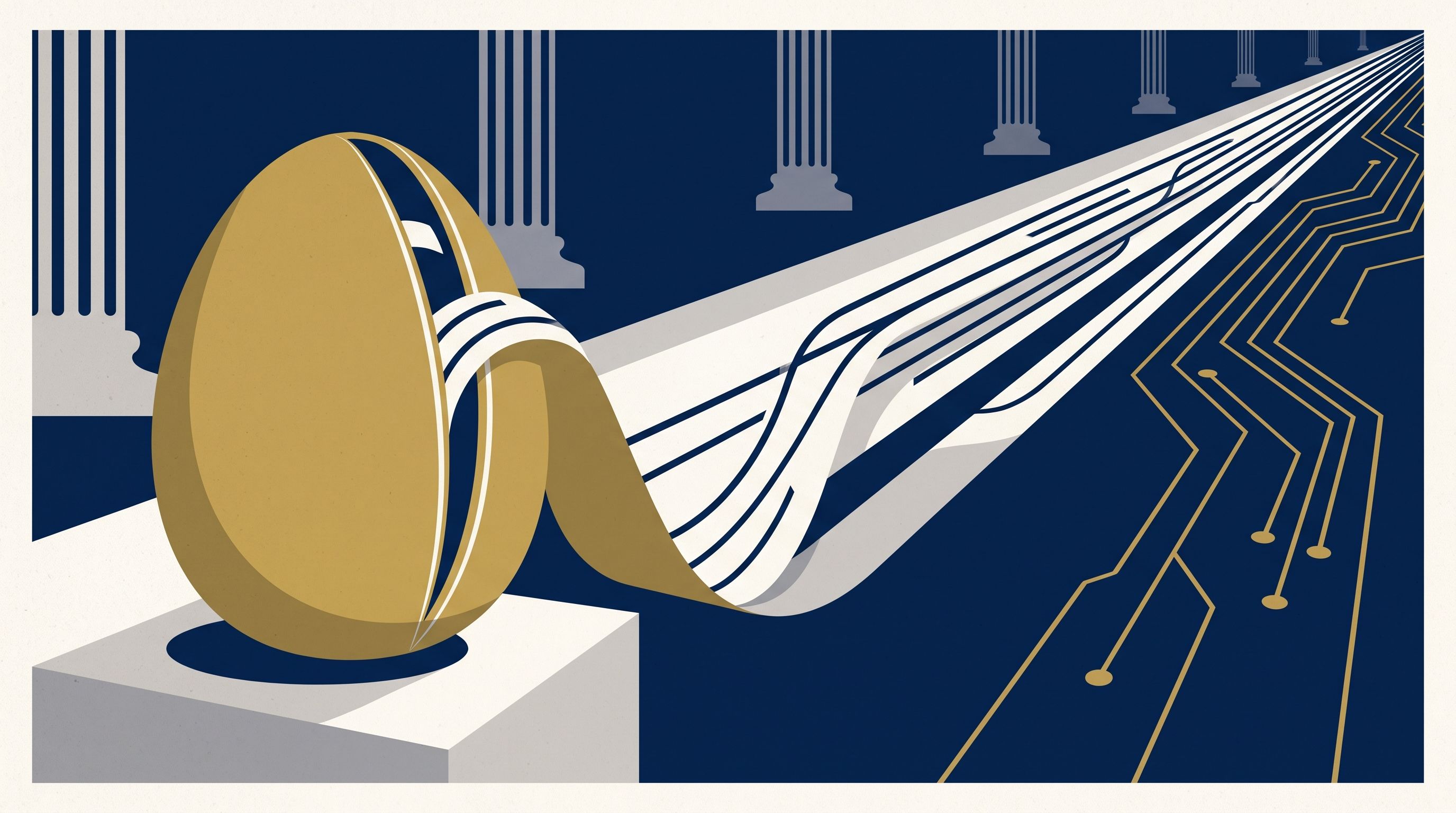
Good evening, reader.
In today's Innovation Commons:
In 1953, a research scientist at the Aeronautical Research Laboratories in Melbourne conceived a device that would record everything happening in a cockpit before a crash (Defence Science and Technology Group).
Australian authorities saw no use for it. His superior told him to drop the idea and get on with blowing up fuel tanks (IEEE Spectrum).
A British Air Registrar saw a lunchtime demonstration in 1958 and put Warren and his box on a plane to England, where S. Davall & Sons of Middlesex built it as the "Red Egg" (DST).
After the 1960 Mackay Fokker Friendship crash killed 29, Australia became the first country in the world to make cockpit voice recording compulsory — a world-first mandate for a device it had declined to develop (Simple Flying).
From 2 August 2026, Article 12 of the EU AI Act requires high-risk AI systems to log automatically, on pain of €15 million or 3 per cent of global turnover (EU AI Act, Article 12).
Australia's National AI Plan, published in December 2025, shelved the proposed mandatory guardrails — record-keeping among them (DISR proposals paper; analysis).
A recorder in search of a listener
In 1953 the world's first jet airliner, the de Havilland Comet, was falling out of the sky and nobody could say why. David Warren, a fuels chemist at the Aeronautical Research Laboratories in Fisherman's Bend, sat on the investigation panels. He had also, around the same time, seen the world's first miniature recorder — the German Minifon, a pocket dictation machine — at a trade fair, and wanted one for recording music.
The two facts collided into an idea that now seems unimprovable: put a recorder in every aircraft, running continuously, built to survive what the aircraft does not. The crash would stop being a mystery and start being a record.
Warren had a private reason to care about unexplained crashes. He was nine when his father died in the loss of the Miss Hobart over Bass Strait in 1934 — an accident that was never explained, because there was nothing to explain it with.
He wrote the idea up as a memo. It was circulated. It produced, in the words of Defence Science's own official history, little interest. So Warren fell back on his early training as a schoolteacher — show beats tell — and built the thing in his own time. By 1957 the ARL Flight Memory Unit existed: a demonstration recorder that continuously stored up to four hours of cockpit speech plus instrument readings.
Still no interest from any authority.
No immediate significance
The rejections are worth dwelling on, because none of them were technical. His superior told him to drop it and get on with blowing up fuel tanks. The civil aviation establishment saw no immediate use for the device. The pilots saw a spy in the cockpit and wanted no part of it.
Every one of these objections understood the invention perfectly. A recording is evidence. Evidence assigns responsibility. Nobody wants to carry the witness. The black box was rejected not because Australia's institutions failed to grasp what it was, but because they grasped it exactly.
This is the part of the story that the plaque version leaves out. The barrier to the flight recorder was never engineering — a chemist built one at his workbench after hours. The barrier was institutional: the device only has value inside a system that compels its carriage, protects its contents from misuse, and turns what it records into shared learning. In 1957, no such system existed anywhere on earth. Warren had built a recorder in search of a listener.
The egg goes to England
The listener arrived at lunchtime. In 1958 Sir Robert Hardingham, secretary of the UK Air Registration Board, paid an informal visit to ARL and was shown Warren's "unofficial project." He saw it at once. Warren and his box were, in Defence Science's phrasing, almost immediately on a flight to England.
The British Ministry of Aviation signalled that recorders might soon be made mandatory. The device was demonstrated successfully in Canada. The Americans declined even to see it. And a firm in Middlesex, S. Davall & Sons, took the design into production in a crash-proof, fire-proof, egg-shaped casing painted in high-visibility red-orange: the Red Egg. The black box, from the day it became a product, was neither black nor Australian.
Defence Science's official history records the consequence in one careful sentence: a continuing lack of Australian support meant that, as the idea finally took off around the world, companies in other countries moved ahead with development, capturing the growing market. No royalties flowed. Warren was recognised with an Order of Australia — in 2002, forty-five years after the prototype.
The mandate after Mackay
Then comes the twist that makes this an Innovation Commons story rather than a lament.
On 10 June 1960, a Trans Australia Airlines Fokker Friendship went into the sea on approach to Mackay, killing all 29 aboard. The Board of Accident Inquiry could not establish a cause — there was, once again, nothing to establish it with. The inquiry judge strongly recommended that flight recorders be installed in all airliners, and Australia became the first country in the world to make cockpit voice recording compulsory.
Read that sequence again. Australia would not fund the box, would not develop the box, and lost the market for the box — and was then first on earth to require the box. The mandate, not the machine, turned out to be Australia's real contribution to aviation.
And the mandate is what mattered. A recorder in one aircraft is a curiosity. A recorder in every aircraft, read out by an independent investigator whose sole statutory objective is prevention rather than blame, feeding findings to every operator and manufacturer in the world through ICAO's Annex 13 — that is an institution. Aviation did not become the safest form of transport because of a device. It became safe because failure was made a commons: every crash, anywhere, became tuition paid on behalf of the entire industry (ICAO Annex 13).
The stack has three layers: the recorder, the requirement, the reader. Warren built the first. The Mackay inquiry forced the second. Annex 13 built the third. Only the first one fits on a workbench.
The new box
Which brings us to 2 August.
On that date the EU AI Act enters full application for high-risk AI systems, and with it Article 12: such systems "shall technically allow for the automatic recording of events (logs) over the lifetime of the system" — logs sufficient to identify situations that present risk, to support post-market monitoring, and to reconstruct what the system did and why (Article 12; AI Act Service Desk). Non-compliance sits in the second penalty tier: up to €15 million or 3 per cent of global annual turnover.
Strip the regulatory prose and the artefact underneath is unmistakable. Continuous recording. Survivability of the record. Read-out after the incident. Reconstruction of the causal chain. Brussels has mandated the flight memory unit for cognition, and the entire conceptual vocabulary around it — incidents, serious-incident reporting, post-market monitoring — is aviation's vocabulary, borrowed wholesale.
There is a market consequence, and it rhymes. Davall's market was not created by airline customers; it was created by regulators. The moment carriage became compulsory, a compliance industry existed. The same is happening now: Article 12 is minting a global industry of AI logging, audit, and assurance tooling, and the firms that will own it are being selected in this decade. Mandates create markets. Whoever writes the rule seeds the industry that satisfies it.
Canberra, 1954, restaged
Australia's position in this second act is uncomfortably familiar.
In September 2024, the government proposed ten mandatory guardrails for AI in high-risk settings — record-keeping and documentation explicitly among them (DISR). In December 2025, the National AI Plan set those mandatory guardrails aside, opting for existing technology-neutral law, voluntary guidance, and a new AI Safety Institute to monitor, test and advise (analysis; Bank Info Security).
The 1954 posture, faithfully restaged: the case is acknowledged, the instrument is declined, the file is circulated. We have seen where that sequence leads — we wrote the canonical version of it. The rule gets written elsewhere, the market gets built elsewhere, and Australia eventually adopts, at full retail price, a standard it once had the chance to define. Readers of The Window is Closed will recognise the shape.
But the history also points at the move still available. Australia's world-first in aviation was never the device — it was the requirement, and later the exemplary no-blame investigator to go with it. The equivalent opening today is not a sovereign logging industry; that ship is loading in Rotterdam. It is the third layer of the stack, the one Article 12 conspicuously lacks: the reader. An AI Safety Institute constituted as an ATSB for algorithms — independent, no-blame, empowered to demand the logs after an incident and obliged to publish what it learns — would give the logs somewhere to go. Records without a reader are surveillance. Records with an Annex 13 are how an industry learns faster than it kills people.
What the recorder was for
The Red Egg only ever asked one thing of the institutions around it: that someone be required to listen. Australia refused for seven years, mandated it first in the world in the eighth, and then let everyone else collect the rent on both the device and the lesson.
The new boxes switch on in thirteen days. The recording will happen; Brussels has seen to that. The question Warren's country has left itself again is whether it will help build the institution that listens, or wait for the funeral that makes it compulsory.
The box remembered everything. The country that built it keeps forgetting.
— The Editor
P.S. Share this on LinkedIn/X to spark conversations with your colleagues.