The Tape Is Talking. Are We Listening?
FY26 wrap: ASX 200 +2.77%, Materials +47%. Two Australias. Extractive paid, converting mediocre.
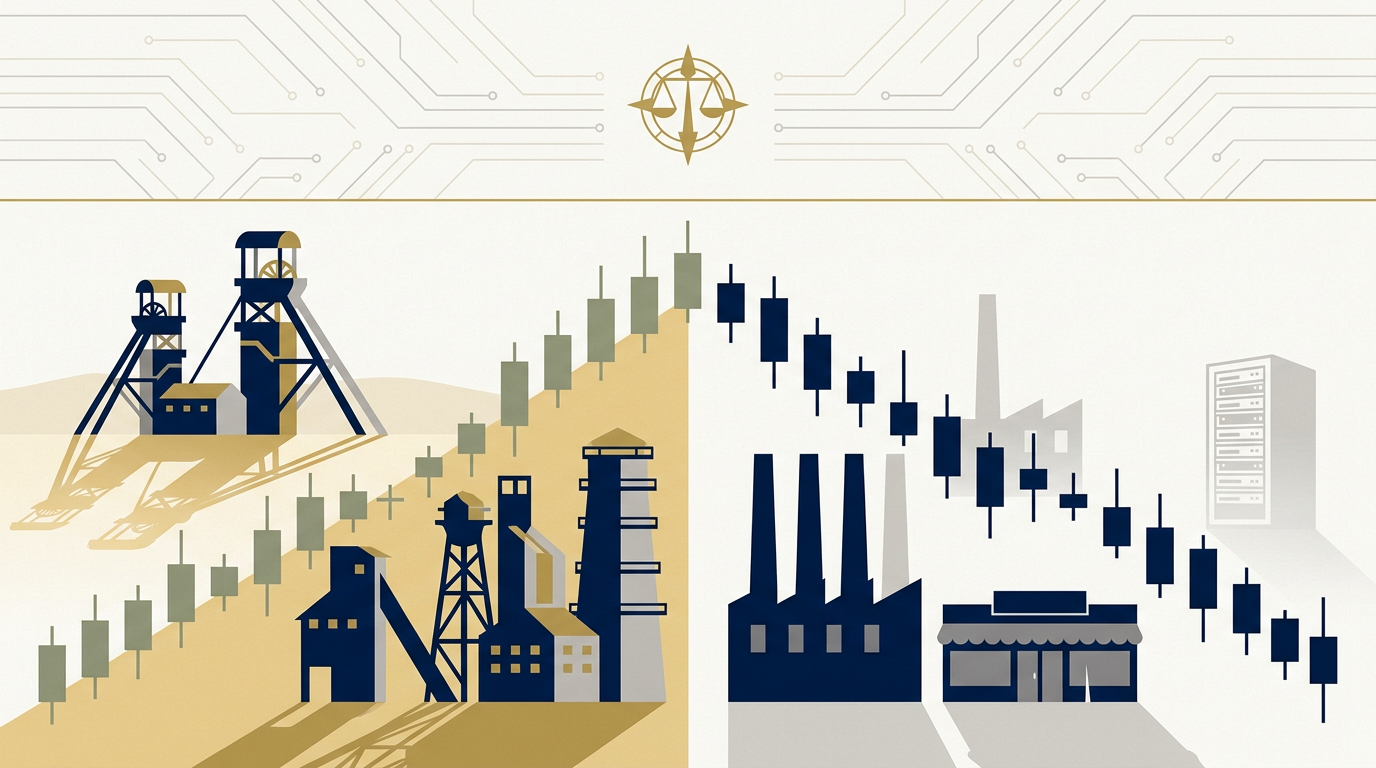
The financial year closed on Monday 30 June. The S&P/ASX 200 finished FY26 up 2.77%, total return 7% including dividends (Perth Now). That number tells you almost nothing. The number that tells you everything is the one hidden underneath: the S&P/ASX 200 Materials Index ran up 47% for the year, outperforming the broader index sevenfold (Bez Kabli aggregator).
Gold cleared US$5,400/oz. Copper cleared US$13,000/tonne. Lithium rebounded hard. Minerals 260 (ASX: MI6) rose 508% across the year. Six ASX 200 large caps returned between 60% and 275% (Motley Fool Australia). Friday 3 July closed with gold miners in the top five: Catalyst Metals +19.18%, Genesis Minerals +16.70%, Northern Star +11.75% (ABC Markets Live). At the same session, PEXA Group dropped 21.29% and Fortescue lost 3.16%.
That is the tape. Now read it.
What is actually being priced
Markets price expected cash flows discounted by expected rates. They do not price virtue, sovereignty, or productive complexity. So when the Materials sub-index runs 47% in a year the broader index barely holds, the market is not telling you Australia has become more sophisticated. It is telling you Australia is still selling the same three things: iron, gold, and lithium concentrate, into a world that has decided it needs more of them.
Gold above US$5,400 is a debasement trade. Copper above US$13,000 is an electrification trade. Lithium's rebound is a battery trade. All three are downstream of American fiscal expansion, Chinese industrial policy, and European energy substitution. None of them are Australian achievements. They are Australian rents.
This matters because we spent FY26 telling ourselves a different story, a sovereign AI story, a national resilience story, a productivity story. The Commonwealth stood up a National AI Plan. AEMO's Integrated System Plan absorbed data-centre load into its 2050 view. The Treasurer's Productivity Roundtable arrived with terms of reference on capital deepening (Treasury).
None of that reached the tape. What reached the tape was the ore body.
The two Australias, priced
Read the FY26 top and bottom together. The winners are pit shafts, processing plants, and grade upgrades. The losers include supermarket integrators, digital settlement platforms, and consumer discretionary names, the parts of the economy where value is created after the ore leaves the ground.
The market is not being irrational. It is being honest. It is pricing what Australia is currently good at (extracting) and what Australia is currently mediocre at (converting). The gap between the two sub-indices is the gap between the country described in the National AI Plan and the country the ASX actually rewards.
You cannot legislate the tape. You can only change the underlying reality it prices.
Baumart, FBR, and the small-cap tell
Underneath the ASX 200, the small-cap board did something more interesting. Baumart Holdings climbed 233% across the week after delivering modular housing units in Western Australia (Bez Kabli aggregator). FBR (the AI welding-robot maker) doubled after a $300,000 director loan.
Both are microcaps. Both are illiquid. Both are exactly the kind of story that gets over-priced on rumour and under-priced on delivery. But both are also the kind of business Australia keeps saying it wants: modular manufacturing, applied robotics, physical productivity. When the market bids them up 200% on a single week's newsflow, the market is not signalling their fundamentals are sound. It is signalling that the free float of this kind of business is so tiny that any real interest moves the price violently.
That is a scarcity signal. Not of capital (Australian super has $4 trillion under management) but of investable industrial complexity. The pipe is thin. The exits are rare. The comparable-set argument that public-market investors need before allocating meaningful capital to industrial capability barely exists.
If FY27 is going to be different, it will be because the pipe widens. That is a governance problem before it is a capital problem.
The ACCC signal
On Wednesday, the ACCC used its new merger powers for the first time to knock back a proposed Coles supermarket in Kalgoorlie (ABC News). The commission did not need to prove competitive harm to a Federal Court standard. It applied the new regime and blocked the acquisition on structural grounds.
Coles's share price took the hit. The signal to the rest of the market was larger than the price move. The ACCC has moved from a litigate-later regime to an approve-first regime, at least for large mergers. Every corporate strategy team in the country now has to model a regulatory outcome the country did not have twelve months ago.
Read this next to Coles's simultaneous talks to acquire Greencross Pet Wellness from TPG (Reuters) and the picture sharpens. Domestic consolidation is now expensive to attempt and cheap to lose. Vertical extension into adjacent categories is the path of lower regulatory friction. The result, at a market-structure level, is that our large domestic operators will look more like conglomerates and less like national champions in any single category, because the ACCC has now made the second option genuinely difficult.
Whether that is good or bad depends on your priors. What it is not is neutral.
The macro picture is boring on purpose
The RBA cash rate sat at 4.35% through the whole reporting period. Headline inflation printed 4.0% year-on-year in May, down from 4.2%. Core inflation ticked up to 3.6%, up from 3.4%. Month-on-month CPI was negative at −0.7%. Unemployment held at 4.4% (Australian Bureau of Statistics, via macro data). Full-year GDP growth for calendar 2025 came in at 2.6%, twice the previous year.
Read as a package: growth without disinflation, employment holding, rates unchanged, core CPI drifting the wrong way. This is a central bank that has decided the cost of cutting is higher than the cost of waiting. Every ASX narrative — the materials boom, the gold rally, the housing microcap spike — has been priced against that unchanged 4.35%. If it moves, half of what got repriced in FY26 gets repriced again in FY27.
The tape is not just talking about materials. It is talking about a market that has become extremely certain the cost of capital is stuck. Certainty like that is the setup for volatility.
Our Perspective
Trading the tape and interpreting the implications of the tape are two different tasks. Stock-picking is out of the scope of this newsletter1 . Instead we consider what the country is being paid to do and to ask whether that is what the country wants to be paid to do.
FY26 paid Australia to dig. It also paid, at the margin, for a small number of applied-productivity businesses that ran up on thin float. It did not pay for sovereign AI, or for domestic advanced manufacturing at scale, or for consumer-facing digital platforms that convert Australian data into Australian value. It paid banks moderately. It paid healthcare late.
If our public policy is going to change what the tape pays for next year, three things need to move together.
First, the pipe of investable industrial capability has to widen. That means the pathway from CSIRO spinout, to Series C, to ASX-listable industrial business has to become an actual pathway rather than a boutique curiosity. It means the National Reconstruction Fund's $15 billion needs to produce companies of a size and shape the ASX can absorb without violently over-repricing them on a single week's news. Baumart at +233% is not a triumph. It is a scarcity artefact.
Second, the ACCC's new posture has to be paired with an industrial policy that gives national champions somewhere to grow into. If domestic consolidation is now expensive, vertical construction has to be cheap. That is a question about permitting, energy costs, and skilled-migration architecture — not about competition law.
Third, we need to stop confusing the resource rally for a national strategy. Gold at US$5,400 is a gift, not a plan. The 47% Materials return is the fiscal window in which we get to build something else. FY27 will either be the year we did, or the year we noticed we didn't.
The read for the week ahead
The ASX opens Monday 6 July with futures down 0.4% at 8,794 (ABC Markets Live) after Wall Street's Friday close. Wall Street starts a heavy US earnings week — the tape's next signal will come from the banks and megacap tech, and it will flow to the ASX through the same channels it did last week. Iron ore continues to hold above breakeven. Gold, after its non-farm-payrolls-driven rally, will price against Fed positioning. Copper will price against Chinese demand data.
None of that is inside Australia's control. What is inside Australia's control is what we do with the fiscal room the tape has given us. The Materials boom is real money — royalties, PRRT, corporate tax. The question for the next twelve months is whether that money flows into productive capacity or into consumption.
Watch three things this week. The RBA minutes on Tuesday, for any softening in the language around core CPI. The ACCC's follow-through on its Kalgoorlie decision — the next merger it either approves or blocks will define whether Wednesday was a one-off or a new operating regime. And the small-cap industrial names. If Baumart and FBR hold their moves, something structural is shifting in how domestic capital is willing to price industrial productivity. If they give it back, we are exactly where FY26 left us.
— The Editor
P.S. Share this article with your colleagues on LinkedIn and Twitter to spark conversations:
1 The Editor is pissed off that he didn’t rotate into SanDisk last October and isn’t over it yet.