What KPMG's day in Canberra exposed
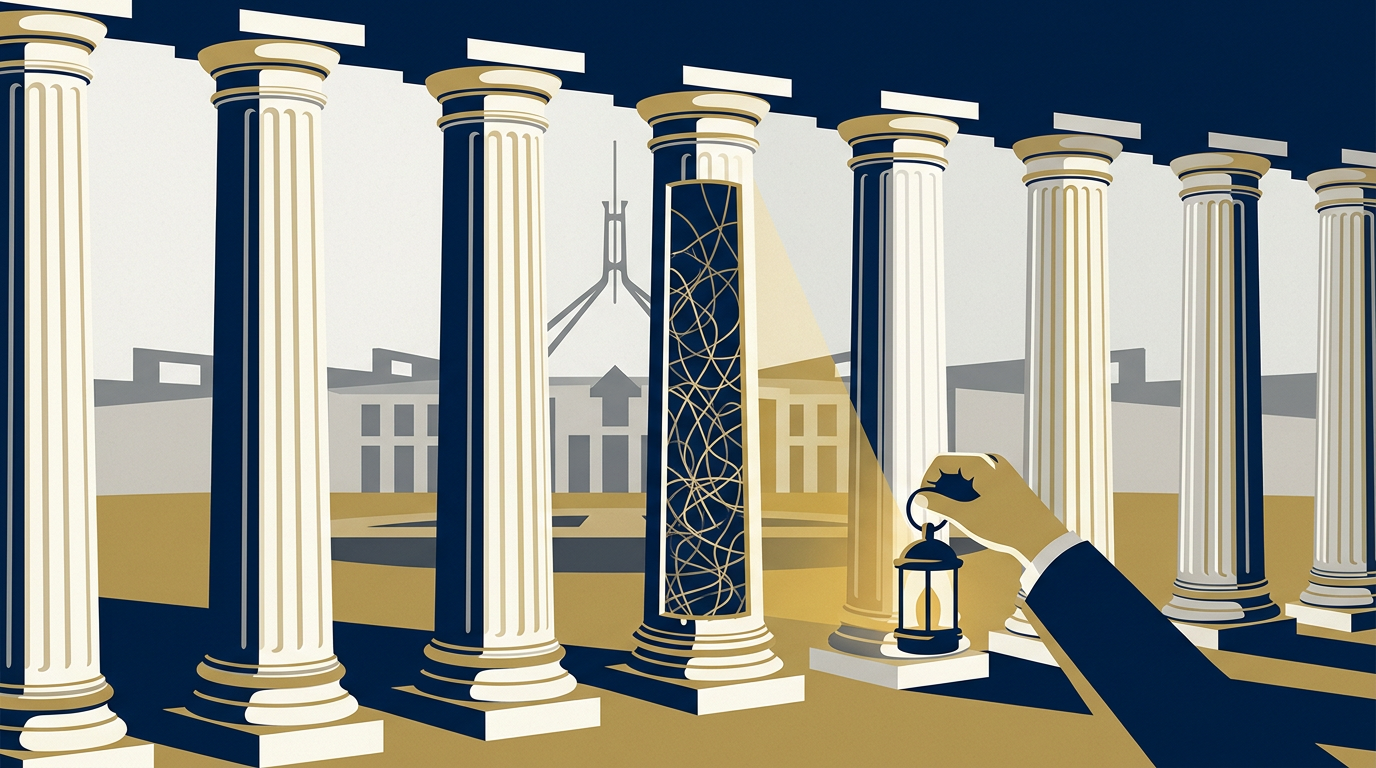
Friday in the Main Committee Room was not a story about bad apples. It was a story about the barrel
Good evening reader,
Friday 19 June 2026 ran ten hours in the Main Committee Room. Thirteen KPMG figures, the firm's international general counsel, Allens, Ashurst, Chartered Accountants ANZ, ASIC, and Lendlease all gave evidence to the Parliamentary Joint Committee on Corporations and Financial Services. This piece is what I think the hearing exposed, once you read past "KPMG behaved badly" and ask why an Australian parliament is spending an entire sitting day asking the same questions about the same kind of firm for the second time in three years.
What happened, in the order it happened
The hearing was the public set-piece of an inquiry building since 24 March, when Senator Deborah O'Neill read whistleblower testimony into Hansard under privilege. The whistleblower, a former senior KPMG executive, alleged partners had used confidential board documents from Lendlease (a client of sixty-eight years!) to support competitive bids at Westpac and Dexus. On 29 May, chief executive Andrew Yates and national managing partner of audit Julian McPherson resigned.
Friday added the under-oath version. Chairman Martin Sheppard confirmed for the first time in public that staff on the Optus audit had transmitted unredacted confidential information to colleagues bidding for the Telstra contract. Lendlease was a second instance, not the only one. Senior employees admitted the whistleblower's laptop had been searched without their knowledge. KPMG did not, at any point, provide independent legal advice to the person who raised the original allegations. It directed them to ASIC's website.
Yates confirmed about one million dollars of his 2025 remuneration had been withheld. He had been paid $3.2 million that year and received a $2.4 million retirement payment on resignation, with additional payments on top. Sheppard denied the sharing had been "for financial gain" and maintained the denial under direct questioning. No senator accepted it. KPMG initially refused to hand over the Allens and Ashurst investigation reports on legal professional privilege. By end of day, after the clerk of the Senate was consulted on the parliament's contempt powers, Sheppard agreed to waive. Former NSW premier Mike Baird, an independent KPMG director, testified his resignation was driven by a lack of urgency and transparency in the firm's response.
ASIC chair Sarah Court appeared last. She confirmed her investigation was being actively hampered by privilege claims and characterised what she had heard as an "egregious breach of trust". Senators across the political spectrum closed by suggesting the Big Four may need to be brought under a regulatory architecture closer to the one governing public companies, rather than the partnership-law architecture that currently applies. That suggestion is the architectural inflection of the hearing.
The partnership form, and why the corporations law cannot reach it
KPMG Australia is a partnership. So are Deloitte, EY, and PwC. They are organised under state-based partnership legislation — the Partnership Act 1958 in Victoria and its analogues — and not under the Corporations Act 2001 (Cth). This is not legacy. It is an actively maintained structural choice, and it is the single most consequential fact about the regulatory architecture of professional services in this country.
Companies under the corporations law file audited accounts publicly. They have continuous-disclosure obligations. Their directors carry codified statutory duties enforceable by ASIC. None of this applies to a partnership. A partnership is not required to publish accounts. Its partners are not directors and do not owe statutory directors' duties. Its internal governance is contractual and invisible to the regulator and the public. Its disciplinary regime is the professional body, whose standards are written and enforced by people drawn from the same firms. The state-based partnership laws were not designed for entities with 8,500 professionals and a billion dollars of annual revenue. They were designed for two solicitors sharing a practice.
Senator Barbara Pocock named the consequence. The Big Four operate, she said, in "a legal grey area" — large enough to be systemic, small enough in legal form to escape the scrutiny that systemic actors normally attract. Senator Paul Scarr was sharper. He told Sheppard KPMG was "hiding behind legal professional privilege while at the same time pretending to be transparent". The hiding and the pretending are both made possible by the form.
The form is constant across the scandals. PwC's 2023 tax-leaks matter was the same kind of failure: confidential information from one engagement repurposed for commercial advantage at another, inside a firm whose internal walls are contractual rather than statutory, with no external regulator able to see across them. The faces change. The form is constant.
Two scandals in three years is a pattern
A single scandal at a single firm is a story about people. Two scandals at two of the four largest firms in the same kind of work, with the same structural feature at their root, inside thirty-six months, is a story about an institutional design. The 2023 PwC matter and the 2026 KPMG matter are the same incident occurring twice in the same architectural configuration. The configuration, not the individuals, is what produces the outcome.
The Greens have referred the matter to the National Anti-Corruption Commission. ASIC has opened a formal investigation. The Reserve Bank will not renew KPMG as the operator of its whistleblower hotline. The finance department has imposed a three-month suspension on new federal bids. Lendlease, after sixty-eight years, is searching for a new auditor. Every one of those moves is ex post. The corrective actions taken after PwC in 2023 addressed symptoms without touching the partnership-law architecture that produced it. KPMG is the consequence: the architecture, untouched, produced the next instance on schedule. That is a sample size of two against the null hypothesis that scandals of this shape are random firm-level failures. The null hypothesis does not survive contact with the second data point.
297 contracts, $653 million, and the procurement habit
Underneath the legal-form question is a procurement question that is equally architectural and considerably less discussed. The federal government currently holds 297 active contracts with KPMG, totalling $653 million. Roughly $330 million expire on 30 June 2026, with renewals now under additional scrutiny. The 297 does not include state contracts, university contracts, or the contracts held by the three other Big Four firms. A 2023 Senate report estimated the four firms collectively held between four and five billion dollars in annual Australian government work, several times the annual operating budget of the federal Department of Industry, Science and Resources. The Big Four's share has grown in roughly the inverse proportion to in-house analytical capacity since the early 2000s.
Over three decades, the state has allowed its in-house analytical capacity to atrophy across a range of policy and operational domains, and filled the gap by buying advice from a market concentrated in four firms — the firms least visible, by their legal form, to the regulators that would otherwise scrutinise systemic providers. The procurement makes them systemically important. The form makes them institutionally opaque. The procurement creates the dependence. The form determines that the dependence cannot be governed in the way other systemic dependencies are governed.
What credible reform would have to do
Three reform proposals are circulating, and they sort cleanly by ambition.
The lowest-ambition is enhanced disclosure under the existing partnership regime. Partner-level compensation disclosure, mandatory rotation of audit partners, expanded whistleblower protections. These address the most visible symptoms. They do not change the load-bearing element. A firm uses confidential information from one engagement to win another not because partner compensation is undisclosed but because the internal walls are contractual and the external regulator cannot see across them.
The middle-ambition proposal is statutory regulation of the professional bodies. Bringing Chartered Accountants ANZ, CPA Australia, the law societies, and the institutes under a single Commonwealth professional standards authority with statutory disciplinary powers, modelled on AHPRA. This substantively changes the disciplinary architecture. It does not reach the partnership form itself.
The highest-ambition, the one the committee's questioning gestured at without naming, is structural. Firms above a defined threshold of size, systemic importance, or public-sector contract exposure would be required to organise under the Corporations Act 2001 (Cth) rather than under partnership law. They would become registered companies, file audited accounts publicly, have directors who owe statutory duties, and become subject to ASIC's enforcement architecture in the same way every other commercial entity of equivalent scale is. The partnership form would remain available to genuinely small practices and would be retired as the operating form of any firm with systemic exposure to the state. That is the credible architectural reform, and the one with the strongest internal opposition from the firms themselves.
The sovereignty question hiding underneath
The architectural reading of Friday is, in the end, a sovereignty reading. A state that cannot perform its own analytical work is dependent on the providers it buys that work from. A state dependent on providers it cannot see inside is dependent on entities that effectively self-govern. The PwC and KPMG matters are both scandals of self-government — the firms governing themselves, on questions of public consequence, with the Commonwealth as the customer rather than the regulator.
The procurement habit of the past three decades was not an accident. It was the cumulative effect of fiscal pressure on agency budgets, the political incentive to reduce public-service headcount, the contestable-advice doctrine of 1996–2007, staff-cap arrangements that survived multiple governments, and the absence of any decision point at which the trade-off between in-house capacity and contracted advice was named as a sovereignty question. Each decision was defensible on its own terms. The cumulative outcome is the architecture KPMG demonstrated on Friday.
These are not the symptoms of a single firm behaving badly. They are the symptoms of an architecture working as it was designed to. The design was not malicious. It was incremental, defensible at each step, and visible in its consequences only at moments like Friday. The work ahead is to redraw the diagram so the next moment like Friday does not need to happen.
— The Editor
P.S. Share this on LinkedIn to drive conversations.